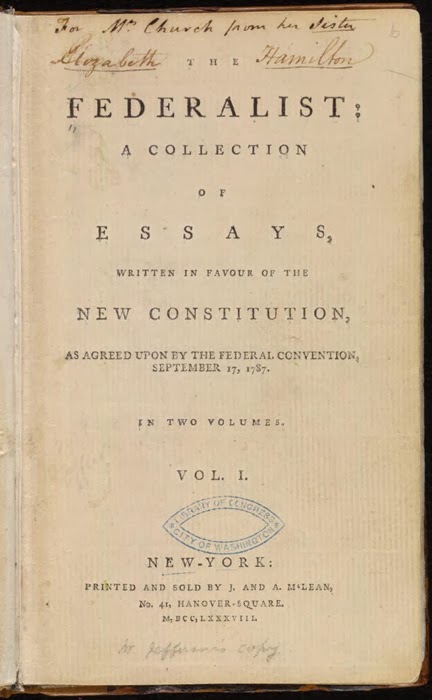
A rowdy debate consumed nearly everyone in the United States
between the Constitutional Convention and ratification. The population of the
country was about four million and possibly a quarter of that
number were activists during the Revolution and founding. What did people think
about a constitution written in secret? We don’t have to guess. A prodigious number of
articles and pamphlets were published by proponents and opponents.
Showing posts with label tempest at down. Show all posts
Showing posts with label tempest at down. Show all posts
Tuesday, February 4, 2014


Sunday, February 2, 2014
Can Tempest at Dawn be taken seriously?
Tempest at Dawn is
a novelization of the Constitutional Convention. As a novel, it is not bound by
the rigorous constraints of a nonfiction history book, but it does not deviate
from the historical record except for modernizating language, re-sequencing of debates for logical presentation, and attributing a few speeches to a different delegate
because that person was already established as a character. It’s confusing to
tell a story with more than sixty characters, so I had to choose a
representative sample and occasionally attribute to them the words or actions
of others.
.jpg "Tempest at Dawn by James D. Best") |
| The real story of our nation's founding. |
James Madison’s
comprehensive convention notes provided a solid framework for what happened inside
the locked doors of the Pennsylvania State House. The events outside the State
House occurred, but literary license was used because there were very few recorded
details about them. For example, Franklin’s dinner, the John
Fitch Steam Boat demonstration, horse races, and George Washington having a carriage built were all outside activities during the convention. The Fourth of July celebration happened pretty
much as portrayed, and delegates did witness a two story house being moved down
the street.
Other than speeches, conversations were speculative, but based to
a large degree on what must have been discussed in private meetings to shift
the votes and opinions expressed in the proceedings.
Sunday, December 8, 2013
What happened in those secret meeting in 1787?
“Can it be of less consequence that the meaning of a Constitution should be fixed and known, than a meaning of a law should be so?”—James Madison
Fifty-five men came to Philadelphia in May of 1787 to
secretly plot the overthrow of the United States government. At first, a coup was not subscribed to by all the participants, but most of them soon acquiesced to framing
an entirely new form of government. At the time, this conclave was called the Federal
Convention; today we refer to it as the Constitutional Convention.
 |
| James Madison, circa convention |
One of the first acts of the convention was to
declare the proceedings secret. There was a general fear that newspapers would
excite Congress and the populace against abandoning the Articles of
Confederation. The windows were nailed shut and guards posted at the doors. Delegates
were lectured by George Washington never to whisper a word to anyone about what
was happening inside the chamber. The official minutes are scanty, recording
little beyond an official tally of the votes. A few delegates made private notes,
but of those, only one attended every day and wrote everything down. James
Madison purposely sat in front so he could take extensive notes of all the
deliberations. He recorded the proceedings in his own shorthand, and then
transcribed his daily notes into longhand. When finally published in 1840, Madison’s
notes exceeded 230,000 words—all written with a quill pen.
Wednesday, August 21, 2013
Balances and Checks
“The
powers of government should be so divided and balanced among several bodies of
magistracy, as that no one could transcend their legal limits, without being
effectually checked and restrained by the others.” Thomas Jefferson

The phrase checks and balances has become so
commonplace, it is often spoken as if it were a single word, but in the
eighteen century, the phrase represented distinctly different concepts. John
Adams may have been the first to put the words together in his 1787 publication,
A Defense of the Constitutions of
Government of the United States, but balances
and checks is the phrase used in The Federalist, and that is the sequence Madison would have thought appropriate.
First balance powers between the branches of government, and then place checks
on those powers so they may not be abused.
Political power
frightened the Founders. They believed that only by limiting government powers
could liberty survive the natural tendency of man to dictate the habits of
other men. The separation and balancing of power with checks was designed to
prevent a majority coalition from taking control of the government. Each branch
was given defined powers, and then each of these powers was limited and checked
by another branch or entity. The system was purposely designed to slow
governmental actions enough to allow due deliberation.
Monday, August 19, 2013
Bill of Rights Trivia
Bills of rights were not new at the time of the
Founding. The 1215 Magna Carta forced King John to respect specified
rights, the English Bill of Rights of 1689 guaranteed rights, and
many states had previously enacted declarations of rights into their state
constitutions.
The call for a Bill of Rights was an
anti-Federalists political weapon against ratification. For many
antifederalists, the real objection was that the Constitution defined a
national government far too strong for their taste. This argument floundered,
while a demand for a bill of rights gained enormous traction with people.
Influential Founders made vocal and repeated demands for a Bill of Rights.
Thomas Jefferson called the omission a major mistake, writing, “A bill of
rights is what the people are entitled to against every government on earth.”
Richard Henry Lee objected to the lack of protection for, “those essential
rights of mankind without which liberty cannot exist.”
At first, the
Federalists argued that the Constitution’s checks and balances constrained the
government so it couldn’t abridge individual rights. But in the Virginia
convention, Patrick Henry denounced the Constitution’s checks and balances,
calling them, “specious, imaginary balances,” and “ridiculous ideal checks and
contrivances.”
 Rights
in the Constitution Prior to the Bill of Rights
Rights
in the Constitution Prior to the Bill of Rights
The base document included a few rights
interspersed throughout the text. Writ of habeus corpus could not be
suspended—except when the country was under attack; no bill of attainer or ex
post facto law could be passed at the national or state level; Americans were
guaranteed a jury trial for criminal cases; there could be no religious test
for federal office, no state law could impair the obligation of contracts, and
the citizens of each state were entitled to the privileges and immunities of
the citizens of every other state.
Saturday, August 17, 2013
Who Wrote the United States Constitution?
The Articles of Confederation proved barely adequate during the
imperative of war and a failure after independence was achieved. A few years
after the Paris Peace Treaty, our military had been reduced to near extinction,
depression and inflation sapped hope, insurrection sprang from civil injustice,
and a confused government tottered
perilously close to collapse. European powers hovered like vultures, eager to
devour the remains.
It looked as if the American experiment was doomed. Then in May of
1787, delegates came to Philadelphia with a congressional charter to revise the
Articles of Confederation. They didn’t revise the Articles. Instead, they wrote
a constitution from scratch for a totally new government. These men carried out
a bloodless coup that replaced an existing government without a shot.
Who were these men? Who wrote the Constitution of the United
States?
 |
| Gouverneur Morris |
The short answer is that Gouverneur
Morris wrote the Constitution, with editing help from other members of the
Committee of Style. In truth, all of the delegates, to a greater or lesser
degree influenced the substance of the Constitution. There were fifty-five
men that attended the Federal Convention, what we now call the Constitutional
Convention. When Thomas Jefferson read the list of attendees, he called them an
“assembly of demi-gods.”
Not exactly, but they were staunch revolutionaries and patriots.
They were also highly successful, well educated, and unswerving in their support
of the republican form of government. They came to Philadelphia committed to
rescuing American from its slide into
anarchy.
A few are household names. George Washington presided over the
convention. James Madison, Roger Sherman, Benjamin Franklin, Alexander
Hamilton, James Wilson, and George Mason were all key delegates. Many of the
rest have been forgotten.
Wednesday, August 14, 2013
Common Misconceptions About the Constitution
I
was inspired to start this blog after listening to a political science graduate
on a talk radio. I was startled to hear her say that she was never required to read the body of
the Constitution, only the Bill of Rights. This brought to mind once again the
three most widespread misconceptions about the Constitution.
- The Bill of Rights is the most important part of the Constitution
- The Bill of Rights guarantees our freedom
- The Constitution is ancient and not applicable to the modern world
The Framers would vehemently disagree with the first myth. Viewing the Bill of Rights as the most important part of the Constitution would go against everything they believed. In fact, many of the framers opposed a Bill of Rights. Even those who supported a list of rights still believed the main body of the Constitution was the linchpin that protected liberty.

Subscribe to:
Posts (Atom)