Showing posts with label government theory. Show all posts
Showing posts with label government theory. Show all posts
Thursday, July 8, 2021

Sunday, January 12, 2020
A Republic, if You Can Keep It . . .
I pledge allegiance to the flag of the United States of America, and to the Republic for which it stands, one Nation under God, indivisible, with liberty and justice for all.

At the close of the Constitutional Convention of 1787, Franklin was queried as he left Independence Hall on the final day of deliberation. In the notes of Dr. James McHenry, one of Maryland’s delegates to the Convention, a lady asked Dr. Franklin “Well Doctor what have we got, a republic or a monarchy.” Franklin replied, “A republic . . . if you can keep it.”

Our Constitution created a limited representative republic. A republic is different from a democracy. In a democracy, the majority can directly make laws, while in a republic, elected representatives make laws. Basically, in a pure democracy, the majority has unlimited power, whereas in a republic, a written constitution limits the majority and provides safeguards for the individual and minorities.
In the United States, we actually have both systems. There is no way for Americans to directly enact legislation at the national level, but half of the states allow ballot initiatives which, if passed by a majority of the voters, have the force of law.
The Founders’ intent at the national level was a representative republic. The word democracy is not mentioned in the Constitution. Most of the Founders distrusted pure democracy. Some had been frightened by Shays Revolt and equated democracy with mob rule. Others were convinced by Madison that different factions would come together until they formed a majority, and then take advantage of those who were not members of their coalition. In fact, Madison showed that throughout history, this phenomenon had destroyed every experiment in democracy.
John Adams wrote that “There never was a democracy yet that did not commit suicide,” and James Madison wrote in Federalist 10 that “Democracies have, in general, been as short in their lives as they have been violent in their deaths.” The reason pure democracies fail is that majorities learn that they can legally take property and/or liberties away from others. Those subjected to abuse can be anyone outside the majority coalition, and their minority status can be based on race, religion, wealth, political affiliation, or even which city or state they reside in. Demagogic leaders become adept at appealing to the emotions of jealousy, avarice, and entitlement. They also denigrate opponents in order to justify prejudicial actions taken by the majority. Soon, oppression of minority classes causes enough conflicts to collapse the democratic process.
A major difference between a republic and a democracy is immediacy. The Founders wanted laws made by representatives in order to put a buffer between popular passions and legislation. In a democracy, decisions are made in the heat of the moment, while periodic elections in a republic provide a cooling off period. To a great extent, democracies are ruled by feelings, while in a republic, the rule of law governs. In a republic, politicians can take principled actions that go against the will of many of their constituents with the knowledge that they will be judged by all the actions they take during their entire term in office. Political leaders are also given time to explain the reasons for their actions.
Of course, if an elected official does something grievously offensive, then the voters can follow the advice of Alexander Hamilton, who in Federalist 21 wrote, “The natural cure for an ill-administration, in a popular or representative constitution, is a change of men.”
When the people’s will is thwarted, regular elections give them the opportunity to dismiss their representatives and appoint new ones.
Saturday, August 31, 2019
Great Labor Day Read
 |
The real story of our nations founding
"The best novel EVER on the U.S.Constitution."--Larry Schweikart, author A Patriot's History of the United States and over a dozen other history books
"I find hope and confidence in the wonderfully written Tempest At Dawn, by James D. Best" Allen Ball, Beaufort Observer "The novel captures the real drama that ensued behind closed doors as they hammered out what is now the oldest living constitution and the foundation of the nation. Read it for its historical value. Read it for its dramatic value. But read it!"--Alan Caruba, Bookviews "Thanks to James Best's masterpiece, Tempest at Dawn, I felt like the 56th delegate at the Constitutional Convention. Using vivid narrative and expressive dialogue, Tempest at Dawn presents all the major issues the Founding Fathers struggled with."--Michael E.Newton, author of Alexander Hamilton and other history books. "This book was absolutely fabulous. When you read, it makes you feel like you are the 56th delegate. If you want a terrific historical fiction book, I recommend you start with this one." Selbrede 40Book Challenge "The book brings our founders to life with great writing, historic accuracy and amazing wit."--On Transmigration |
Tuesday, February 20, 2018
Constituting American Begins Eighth Annual 90-Day Study
 |
| The core mission of Constituting America is to educate Americans about the Constitution |
Constituting America has initiated its eight annual 90-Day Study. This year, the study is titled Fire on the Floor, and looks at the "Founders’ vision and purpose for a legislature that belongs to, is comprised of, and serves the American people." The essays have already started posting, so take a read here.
I've agreed to write essays on these five subjects.
- Why the Legislative Branch is listed first in Article I of the United States Constitution
- How Congress is designed by America’s Founders so a king could not rule, but instead the American people rule within a civil society
- The United States Congress versus the Confederate Congress During the Civil War
- What should and should not be placed in a bill to keep legislation easy to understand and appropriate
- Impact that running for elected office, and serving in Congress, has on the members and their families
 |
| 2018 Essays |
Monday, January 29, 2018
Ryan Cooper writes "America's Constitution is terrible"

Ryan Cooper has an opinion piece in The Week with the provocative title, "America's Constitution is terrible. Let's throw it out and start over."
He starts by saying, " The American
Constitution is an outdated, malfunctioning piece of junk — and it's only
getting worse."
What's wrong, you say? Well, that damned parchment is
interfering with him and his cohorts from governing in the fashion they believe best for all of us. How will we ever turn the United States into a European country
with that odious “piece of junk” in the way?
He has a prescription, of course. As the intellectual equal
of James Madison, Alexander Hamilton, Benjamin Franklin, et al, Cooper defines
five brilliant changes to our countries most sacred document.
- Get rid of the Senate filibuster—super majorities are undemocratic
- Radically change the way House members are elected—gerrymandering is just plain wrong
- Neuter the Senate—too damn much power to low-population states
- Elect the president from the House—a separately elected president “increases tyranny and undermine democracy”
- Throw the entire Constitution in the garbage—git rid of the “ancient, janky mechanisms of the American Constitution”
Thursday, May 19, 2016
The First Presidential Campaign—George Washington, 1788-89

The following essay was first published in Constituting America.
George
Washington won the first presidency under the newly established Constitution.
He ran unopposed, professed not to want the job, and remained for the most part at
Mount Vernon, yet won unanimously. Many believe he never campaigned, but instead
acquiesced to a call to duty from his countrymen. Perhaps it was not so simple.
People
think of Washington as a man of honor who won a war through strength of character
and perseverance, and as a president who didn’t cling to power. From our
perspective in time, he appears etched-in-marble and stiff as a board. Washington
was tall, stately, reserved, and preoccupied with his reputation, but he also
loved to dance, play cards, socialize over meals, and attend the theater. He
was a superb horseman, ran his plantation with a sharp eye for profit, and
attended church regularly. Washington was a vibrant, athletic man who wanted
most of all to be loved by his countrymen.
Washington
was the preeminent politician of his age and maintained good relationships with
all the significant people in the country. To say he didn’t campaign for the
presidency is to ignore decades of relentless politicking. (When Dwight
Eisenhower was told he was not a politician, he replied that no one could
become General of the Army without being a politician.) Washington bragged he
never ate alone, made sure he was a central figure in all the founding events,
collected a cadre of bright and capable people, and understood branding well
before Madison Avenue had a clue.
Sunday, August 23, 2015
Is the US Constitution Viable in the 21st Century?

Today, many people question the viability of our Constitution. People ask if 18th
century men could anticipate the complex issues of the 21st Century. In other
words, can something written over two hundred years ago direct a government in
our modern world? The short answer is yes, but let me explain.
When James
Madison brought the Virginia Plan to Philadelphia, it was not a list of laws,
but a system of government. A system that forthrightly recognized the
weaknesses of man, and delineated a set of checks and balances to distribute
power; not just between the three branches of government, but also between the
federal government and the states.
Although the
delegates debated endlessly over the elements of the design, and made major
revisions to Madison's plan, they always kept the debates focused on limiting
centers of powers. They were serious men designing a system of government for
the ages to protect liberty for themselves and their posterity. Although not a
common phrase at the time, every one of the fifty-five men at the Federal
Convention would agree with the maxim that power corrupts, and absolute power
corrupts absolutely.
Friday, July 3, 2015
Celebrating Independence Day in 1787 While Drafting the Constitution

The following excerpt from Tempest at Dawn describes the Independence Day celebration held during
the Constitutional Convention. The events and Reverend Campbell’s words are
accurate to the historic record.
BOOM! BOOM! BOOM!
The cannon fire hurt James Madison’s ears and teared his eyes as concussions pounded his body. Sulfuric mephitis scratched his throat, and the rotten egg odor made him queasy. The thirteen reports ended, but before Madison could draw a grateful and tranquil breath, the artillery brigade started another round.
After three consecutive resounding salutes of thirteen cannon shots, Madison felt exhausted. He had been jostling for a position from which to see the Independence Day celebration when the cannon fire assaulted his senses. The State House Commons throbbed with people keyed up with rum and excitement. The crowd churned on the periphery of the Commons, while the Society of the Cincinnati, the City Calvary, the Light Infantry, and a battalion of militia vied for attention in the center of the swirling people. Each military formation, spruced up in their finest regalia, stood eager to demonstrate their parade skills. The units waited, as did Madison, for the artillery to finish their noisy salute.
Philadelphia, as the site of the signing of the Declaration of Independence, took pride in holding the rowdiest Fourth of July gala in the nation. Festivities would go from dawn until deep into the night. The city echoed with public celebrations, ringing bells, and martial music. Every church would conduct special devotionals, and all 117 taverns would compete for revelers with loud entertainment. The formal celebrations had started early in the morning, with city officials, aspiring orators, and preachers making the customary thirteen toasts.
Wednesday, April 30, 2014
Book Review: Freedom’s Forge—How American Business Produced Victory in World War II
“Leave nothing to the uncertainty of procuring a warlike
apparatus at the moment of public danger.”
George Washington Fifth Annual Message to Congress

Freedom’s Forge by Arthur Herman is a celebration of
people who know how to build things. The book is filled with characters that seemingly
came from Ayn Rand’s novel Atlas Shrugged
… except these Americans were not fictional. They were real industrialists and
miracle makers. In 1939, the United States possessed only skeletal armed forces, ranking eighth in the world behind
tiny Holland. Production plants in the United States had become obsolete or run
down by depression and harmful tax policies. America was ill-prepared for war
and did not have factories that could change the situation. By 1942, from this
standing start, American industry was producing more war materials than
Germany, Japan, and Italy combined, and by the end of the war the United States
had manufactured two-thirds of all war materials used by the Allies.
Wednesday, April 16, 2014
The Three Clauses That Have Caused Much Mischief
The Founders
wanted to bequeath to posterity a straightforward government that inhibited the
abuse of power. Their written words remain clear. Certain politicians and
judges have skewed their meaning to do what they want, but most of the harm can
be attributed to three clauses:
1. The necessary and proper clause,
2. The commerce clause,
3. And the general welfare clause.
It is
nonsensical to assert that the Founders meant for any of these clauses to
license general national authority.

Friday, March 28, 2014
John Adams, Philosopher Rebel
John Adams was the leading expert on
government in the colonies … at least until James Madison stepped to the
forefront. Harvard educated, Adams was a champion of the Founding Principles, a
firm proponent of Enlightenment teachings, and a constitutional scholar.
Granted, he could be argumentative and self-righteous, but he was also a pious
man of honor and character.

Friday, March 14, 2014
The Happiness or Misery of Millions Yet Unborn

(Excerpt from Principled Action)
The truly exceptional work in the founding began after the war for independence was won. During the Constitutional Convention , George Mason wrote, “The revolt from Great Britain and the formations of our new governments at that time, were nothing compared to the great business now before us; there was then a certain degree of enthusiasm, which inspired and supported the mind; but to view, through the calm, sedate medium of reason the influence which the establishment now proposed may have upon the happiness or misery of millions yet unborn, is the object of such magnitude, as absorbs, and in a manner suspends the operation of the human understanding.”
The writing and ratification of the Constitution made the United States of America unique. The origins of our republic were not by the sword, but through the calm, sedate medium of reason. There was a long and bloody revolution, but four years of peace had calmed the infant nation before the Founders collectively sat down to debate the design of a republic for millions yet unborn.
Sunday, February 23, 2014
The Anti-Constitution Mercenaries

In the past,
I blogged at What Would The Founders Think? One of my articles was
titled, “The
Founders Fear.” The article asserted that the Founders architected a
limited government because they feared unrestrained power. This was written way
back in 2011, but I received a scolding from a troll last week. Reeve wrote:
Monday, February 10, 2014
Why did the colonists revolt?
In the five centuries following the Magna Carta (1215),
Englishmen had gradually gained individual rights, so that by the late
eighteenth century, the English were beginning to exercise a degree of
self-government. The King and nobility still wielded substantial power, but
Parliament had gained increasing authority, especially the elected House of
Commons.
Toward the end of this period, the opinions of those outside the aristocracy were increasingly influenced by the Enlightenment, an intellectual movement of the seventeen and eighteenth centuries. Enlightenment thinkers began to challenge existing religious, government, and social norms, and pushed for additional individual liberty and the free exercise of natural rights. They argued that mankind not only had a capacity for self-government, but that it was a natural right. Through an evolutionary process, Englishmen grew to enjoy an ever-increasing say over who made the laws that governed their lives. That is, those Englishmen who lived in England. If an Englishman happened to live in one of the British colonies, he was still a mere subject of the crown with no representation in Parliament.
Toward the end of this period, the opinions of those outside the aristocracy were increasingly influenced by the Enlightenment, an intellectual movement of the seventeen and eighteenth centuries. Enlightenment thinkers began to challenge existing religious, government, and social norms, and pushed for additional individual liberty and the free exercise of natural rights. They argued that mankind not only had a capacity for self-government, but that it was a natural right. Through an evolutionary process, Englishmen grew to enjoy an ever-increasing say over who made the laws that governed their lives. That is, those Englishmen who lived in England. If an Englishman happened to live in one of the British colonies, he was still a mere subject of the crown with no representation in Parliament.
 |
| Benjamin Franklin before Lords in Council in Whitehall Chapel |
Friday, February 7, 2014
Our American Heritage
The colonists did not only revolt against taxes; they
revolted to stop the British from taking away the self-governance they already
had been exercising since the earliest colonization. The crown appointed
governors for the colonies, but over three thousand miles of ocean in the day
of wind-powered ships gave ordinary Americans more freedom than a minor noble
living in Bristol, England. (Connecticut and Rhode Island even elected their
own governors.) Americans bristled over dictates from Parliament because
colonial legislatures had been exercising substantial power for well over a
century.
 |
| Plymouth Plantation Today |
Tuesday, February 4, 2014
A Time of Civil Debate
A rowdy debate consumed nearly everyone in the United States
between the Constitutional Convention and ratification. The population of the
country was about four million and possibly a quarter of that
number were activists during the Revolution and founding. What did people think
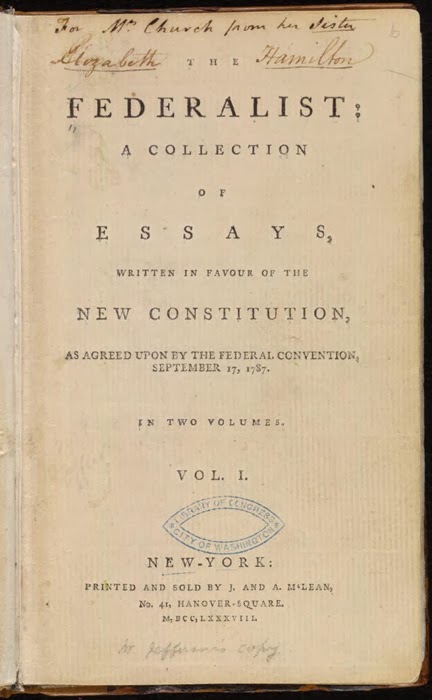
about a constitution written in secret? We don’t have to guess. A prodigious number of
articles and pamphlets were published by proponents and opponents.

Sunday, February 2, 2014
Can Tempest at Dawn be taken seriously?
Tempest at Dawn is
a novelization of the Constitutional Convention. As a novel, it is not bound by
the rigorous constraints of a nonfiction history book, but it does not deviate
from the historical record except for modernizating language, re-sequencing of debates for logical presentation, and attributing a few speeches to a different delegate
because that person was already established as a character. It’s confusing to
tell a story with more than sixty characters, so I had to choose a
representative sample and occasionally attribute to them the words or actions
of others.
.jpg "Tempest at Dawn by James D. Best") |
| The real story of our nation's founding. |
James Madison’s
comprehensive convention notes provided a solid framework for what happened inside
the locked doors of the Pennsylvania State House. The events outside the State
House occurred, but literary license was used because there were very few recorded
details about them. For example, Franklin’s dinner, the John
Fitch Steam Boat demonstration, horse races, and George Washington having a carriage built were all outside activities during the convention. The Fourth of July celebration happened pretty
much as portrayed, and delegates did witness a two story house being moved down
the street.
Other than speeches, conversations were speculative, but based to
a large degree on what must have been discussed in private meetings to shift
the votes and opinions expressed in the proceedings.
Tuesday, January 28, 2014
How to study the Constitution
The study of the
Constitution can seem daunting to those who want to gain a greater
understanding of this unique document. To begin with, there are eight historic periods
that shaped our Constitution.
- Constitutional Convention
- Public debate on Constitution as reflected in the Federalist and Antifederalist Papers
- State Ratification Conventions
- First Congress and Bill of Rights
- George Washington precedents
- Supreme Court Rulings
- Amendments beyond the Bill of Rights
- Executive encroachment with emphasis on Jefferson, Lincoln, Wilson, FDR, and Obama
As a constitutional conservative, I recommend starting with
the convention and the Framers. Besides, it’s always a good idea to start at
the beginning.

There are countless history books on the Constitutional
convention. In these books, the convention is usually presented in one of two
ways: chronologically or by subject.
Tuesday, January 21, 2014
The Atlantic Joins the Chorus: Constitution Defunct
 |
| Alex Seitz-Wald |
“America, we've got some bad news: Our Constitution isn't
going to make it.” That is the lead sentence in The Atlantic article: “The U.S. Needs a New Constitution—Here's How to Write It,” by Alex Seitz-Wald, Salon's political reporter. Seitz-Wald
quotes none other than Thomas Jefferson to justify his claim that “it's time to
think about moving on.” Jefferson had famously written that Constitutions
should be rewritten every nineteen years. Jefferson certainly qualifies as a
founding father, but he had nothing to do with the Constitution. He was in
Paris in the summer of 1787 and returned miffed that he had been left out. None
of the actual delegates wanted to repeat the convention experience, and all
believed they had written a constitution for what George Mason called “millions
yet unborn.”
Seitz-Wald writes, “If
men (and, finally, women) as wise as Jefferson and Madison set about the task
of writing a constitution in 2013, it would look little like the one we have
now.” I suspect those wise men and women would all be required to think in
lockstep with Mr. Seitz-Wald. Again, not
true of the 1787 delegates who possessed myriad ideas and perspectives.
Sunday, January 19, 2014
Time Magazine: “Does It Still Matter?”
“Let us not make it a blank paper by
construction. ... If it is, then we have no Constitution.” Thomas Jefferson
“Can it be of less consequence that the meaning
of a Constitution should be fixed and known, than a meaning of a law should be
so?” James Madison

The cover of the 10th Annual Time Magazine History Issue
from a couple years ago shows the Constitution being shredded under the title,
“Does it still matter?”
Richard Stengel, Time’s managing Editor, opens his essay
with these words, “Here are a few things the framers did not know about. World
War II. DNA. Sexting. Airplanes. The atom. Television. Medicare. Collateralized
debt obligations. The germ theory of disease. Miniskirts. The internal
combustion engine. Computers. Antibiotics. Lady Gaga."
Subscribe to:
Posts (Atom)