Showing posts with label tempest at dawn. Show all posts

Monday, March 16, 2026

Tucson Festival of Books

The Tucson Festival of Books is the largest free book fair in the nation. It's a great adventure, and if you did not attend this year, you'll just be another year older when you do. 

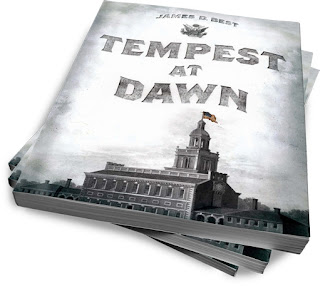
Three of my books were highlighted: The Shopkeeper, The Shut Mouth Society, and Tempest at Dawn.


Lots of great presentations. This is C. J Box, Ellie Cosimano, and J. A Jance talking about book series. Great discussion.

Thursday, February 19, 2026

2026 Tucson Book Festival: March 14th and 15th


On March 14 and 15, on the University of Arizona campus, more than 130,000 readers and over 300 authors will celebrate the written word at the 2026 Tucson Book Festival.  If you can, come and join the party.

The Tucson Book Festival is one of the largest book fairs in the nation. I’ll be there, and so will my books. Well, at least three of them. Tempest at DawnThe Shopkeeper, and The Shut Mouth Society will be featured at the Wheatmark Booth, #159. I am signing books on Sunday and will post an update after I am assigned a time slot.

Hope you can make it!


Wednesday, December 2, 2020


Jennifer N. Fenwick has written an excellent blogpost titled Government of the People, by the People, for the people – What That Truly Means. In the process of deftly describing our heritage, she gives a nice shout-out to Tempest at Dawn

Many of the compromises, though hard for us, some two-hundred years on, to understand, were born from necessity. For a compelling inside look at that Summer in 1787, I encourage you to read Tempest at Dawn, by James D. Best. Based on the diaries of Madison and other delegates, along with correspondence and other written records of the day, Best’s book is like having a front-row seat to the Convention and the writing of our Constitution.

Fenwick is the author of several books including, In the Eye of the Storm: Stories of Survival and Hope from the Florida Panhandle.


Sunday, February 9, 2020

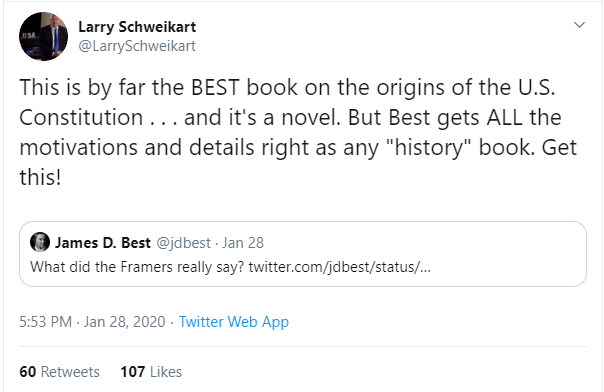
Nice Endorsement for Tempest at Dawn


Who is Larry Schweikart? He’s not only a history guru, he’s a tenured college professor, who once lectured in the halls at the University of Dayton. There, he taught history for 20 years and literally “wrote the book” on the subject. A Patriot’s History. Actually 25 books and counting. Many, New York Times #1 best sellers.

Larry Schweikart books on Amazon

Thanks for the kind words, professor.

Saturday, October 19, 2019

James Madison warning against democracy at the Constitutional Convention


Recently, there's been a lot of blathering about how our country should become more democratic. There is special fury aimed at the Electoral College. One conservative defense is that the Framers never intended the United States to be a pure democracy. Many times this rational is thrown up without explaining why the framers believed democracy destroyed liberty. Since James Madison has been referred to as the Father of the Constitution, I'll let him explain the dangers of  democracy. 


(As a background note, at the time of the Constitutional convention, Madison didn't technically own slaves. His father owned Montpieler and its slave labor force. This is not an excuse, but an explaintion of why he might have felt free to use slavery to illustrate his point.)


Madison made comments similar to the following on June 6th, 1787.


Excerpt from Tempest at Dawn

Madison made a few more comments on the role of the national government but then could not contain himself. Without preamble, Madison charged into new terrain. “Gentleman, all societies divide into different sects, factions, and interests. Conflicts grow between the rich and poor, debtors and creditors, landed and commercial interests, this district against that district, followers of this political leader or that political leader, disciples of this religion or that religion.

“When a majority unites by passion or common interest, the minority is in grave danger. What can restrain a majority? Not respect for others, nor conscience. In Greece and Rome, the patricians and plebeians alternately oppressed each other—with equal ferocity. We’ve seen the mere distinction of color, in our supposed enlightened time, furnish the grounds for the most oppressive dominion ever exercised by man over man.”

With this last, startled gasps escaped from various corners of the room. Madison tried to ignore the reaction. His indictment of slavery had been unpremeditated, but now that it had escaped his lips, he couldn’t recall it.

“Who imposed these unjust laws? The majority. Debtors defraud creditors. The holders of one type of property throw a heavier tax on other types of property. When a majority has the opportunity, they will always threaten the rights of the minority.” Madison shifted his gaze across the sea of delegates. “Make no mistake, in a republic, the majority always has opportunity!”


https://amzn.to/2P3geK2
The real story of our nation's founding.


Saturday, March 10, 2018

Boston Libraries and Tempest at Dawn

Matador contributing editor Sarah Park has “curated” two galleries of fascinating libraries around the world. These links will take you to some interesting buildings dedicated to the written word.


tempest at dawn
Boston Public Library

I’ve used the Boston Public Library to illustrate this post because I spent untold hours in this room. Actually, I found my greatest treasure in the basement of this building. I was researching Tempest at Dawn and discovered Christopher Collier’s doctoral thesis on Roger Sherman. Collier is the coauthor of Decision in Philadelphia, among other books. I was able to speak to him on the phone, and he had no idea that his thesis had been preserved on microfiche or that it was retained by the Boston Public Library. Since information on Sherman was relatively rare, it was fortuitous to find this academic profile about the architect of the Great Compromise at the Constitutional Convention.

Since I’m writing about my time in Massachusetts, there were two other libraries that had an impact on my writing— the Concord Free Public Library and the Boston Athenæum. One is public and home to great literary traditions and the other is one of the oldest private libraries and cultural institutions in the country. I suggest Sarah Park do a third gallery of libraries dedicated to unique institutions in the United States.

Tempest at Dawn
Boston  Athenæum
Tempest at Dawn
Concord Free Public Library


Friday, February 9, 2018

On Transmigration Reviews Tempest at Dawn

In an article titled "Books: An Observation," The Cajun writes:

"The only new title that knocked my socks off is "Tempest at Dawn" by James D. Best, published in 2009.  I've finished it and plan to read it again, after a spell.  There is a lot there to absorb and enjoy.  I know I missed many things as I read it quickly - it's a compelling read - and the second time I plan to read more slowly and savor each character, and there are many historic figures involved. I also began looking up his other works and maybe add a few of them to my collection.
The book brings our founders to life with great writing, historic accuracy and amazing wit."


Thanks for the kind words.

Thursday, September 21, 2017

Musings About Concord, Massachusetts

I don’t believe in muses. Writing is not a matter of inspiration. It's more of a compulsion. Think about all of the famous authors that wrote until the last shovel of dirt was thrown onto their grave. Most people retire when the get enough money. Not bestselling writers. They just keep going. They write because they loved writing. 

That said, I actually have a muse of sorts. It’s Concord, Massachusetts. Some of my fondest memories are of that historic village about twenty-five miles north/west of Boston.


American Revolution
Colonial Inn
I lived in Boston for three years and consulted there for many many more. When I was consulting, I frequently spent two weeks in the city. I discovered that I could catch a commuter train Friday night and spend the weekend in Concord. I must have done this dozens of times, sometimes with my wife, but often alone.

Concord was peaceful, pleasant, and friendly. I stayed at the Colonial Inn, where in 1775, rebels had hidden guns and ammunition. The shot heard ‘round the world was only a mile or so down the road. Tourists visit Concord because of its iconic place in the American Revolution. Many are surprised by the town’s grand literary heritage. Nathanial Hawthorne, Ralph Waldo Emerson, Henry David Thoreau, Louisa May Alcott, Doris Kearns Goodwin, and Robert B. Parker have all called Concord home. No wonder Henry James dubbed the village, "the biggest little place in America."