
Read my article in American Thinker.
Read my article in American Thinker.

Book 2 in the American Exceptionalism Series
(Ebook, Hardcover and paperback)
“I enjoyed this.”
Harold Holzer, Lincoln Prize winner and Chair of The Lincoln Forum
"See Lincoln as you've never seen him before as he navigates the maelstrom of the Civil War."
Larry Schweikart, NYTimes #1 Bestselling author
Maelstrom tells the story of the greatest rivalry in American history. Abraham Lincoln and Jefferson Davis led their nations in a must-win fight, and Maelstrom shows how each dealt with the same issues, countered the other’s moves, led their respective governments, and used their political powers to sway the outcome.
Read the first chapter free HERE.

Lincoln at Gettysburg, The Words that Remade America by Garry Wills
Lincoln at Copper Union, The Speech that Made Abraham Lincoln President by Harold Holzer
Each of these books covers a single important speech by Abraham Lincoln. The Cooper Union Address set a course for his presidential quest and the famous Gettysburg Address reset the course of the war. The speeches were delivered about three and a half years apart. The Cooper Union Address was given in New York City on February 27, 1860, prior to Lincoln’s nomination as the Republican presidential candidate. The Gettysburg Address was delivered on November 19, 1863, about four months after the battle.
Both books are highly readable and well researched. Wills’ won the Pulitzer Prize with Lincoln at Gettysburg and Holzer’s won the Lincoln Prize with his book about the Cooper Union Address.
It might seem hard to write an entire book about a single speech, but Wills and Holzer had no difficulty filling the pages. More important, readers will have no problem gobbling them up. The books are kept interesting by providing context, motivations, lifestyle, period travel, and supposed Lincoln collaboration with others in his political circle. I say supposed because Lincoln sought out advice and gave everyone the impression that he valued their suggestions and edits, however he used these changes sparingly. To a degree, this was a Lincoln technique to build support for an address prior to delivering it.
The pair of speeches have many similarities. Both were high-minded. Both had an important objective. Both advanced the abolition of slavery. Both were crafted to be heard and read. Both surprised their audiences. Both were memorable. They also had differences, the greatest being length. The Cooper Union Address was nearly an hour and at over seven thousand words, one of Lincoln’s longest speeches, while the Gettysburg address took only two minutes to deliver and contained a mere 272 words.
If you are interested in Abraham Lincoln or how to craft a great speech, these books are indispensable. They are well written, thoroughly researched, and fascinating reads.

The Radical and the Republican
Frederick Douglass, Abraham Lincoln, and the Triumph of Antislavery
Politics
by James Oakes
Several books study the relationship between Abraham Lincoln and Frederick Douglass. Brian Kilmeade’s The President and the Freedom Fighter was published more recently, but since I have not read Kilmeade’s treatment, I am unable to compare them.
The Radical and the Republican is a balanced view of a pair of critically important men in American history. Since Lincoln and Douglass did not meet until nearly two and a half years into Lincoln’s first administration, the majority of the book reports their personal history and views separately, as if they were on parallel tracks toward the same goals. Except the tracks were not parallel. Although you could not prove it by Lincoln’s utterances, I believe their slavery goals were the same, but the strategy and tactics were so wide apart that Douglass doubted that Lincoln was an ally in his cause.
I think the following two quotes from the book succinctly summarize how Lincoln crafted his strategy. The first is from Lincoln and the second is an assessment of his political talent by James Oates.
“With public
sentiment nothing can fail; without it nothing can succeed. Consequently, he
who molds public sentiment, goes deeper than he who enacts statutes or
pronounces decisions. He makes statutes and decisions possible or impossible to
be executed.” Abraham Lincoln
“He was so in
tune with the movement of public opinion that he could calibrate his own moves
with astonishing skill.” James Oats
For those with an interest in the history of American slavery,
The Radical and the Republican tells the story of how these two men overcame
the huge obstacles that stood in the way of emancipation. Even when they weren't in partnership, they were partners. Partners who eventually became fast friends.

Abraham Lincoln and The Second American Revolution by James M. McPherson
This book is a collection of seven essays on the Civil War. Originally,
these essays were lecture notes. They are well written and thoughtful. The
common theme is that the Civil War was a second revolution because it resulted
in revolutionary transformations of the country and was accompanied by a
counter-revolution a couple decades after Appomattox. Each essay covers a
single premise and can be read separately.
Slavery divided the nation in 1787 and severed the nation in
1860. Many have said that the Civil War settled the key issue kicked down the
road by the Constitutional Convention. Did the Civil War finish the Founders’
work or was it in and of itself revolutionary? Read Abraham Lincoln and The
Second American Revolution and decide for yourself.
Ending slavery in the United States was horrendously
difficult. It took a four year war with about 620,000 deaths. The politics were
byzantine and the warfare brutal. Reunification was even more ferocious, and absent
Lincoln, the backsliding undid much of the accomplishment.
In the end, I found this to be a sad book.

When asked, what sort of man is Grant, Lincoln replied that Ulysses S. Grant was “the quietest little fellow you ever saw. The only evidence you have that he’s in any place is that he makes things git! Wherever he is, things move."
Lincoln explained that every other general briefing him before a battle told him that he was short some crucial resource to ensure victory, but, if ordered, they would proceed anyway. This essential resource was almost always cavalry. Lincoln claimed their real purpose was to shift responsibility to him. When Grant took charge, he immediately recommended reassigning twenty thousand horseless cavalrymen to the infantry. Since there was no way to acquire horses for every man designated as cavalry, these idle soldiers were only held in reserve as a handy excuse. Grant recognized the duplicity and removed the excuse before his first battle.
In this biography, Bruce Catton does an excellent
job describing the man and his military philosophy. Grant reminded me of
General Patton, a warrior through and through. Both believed that to decrease
casualties in war, you don’t minimize the fallen in a specific battle, you win
the war to stop the killing.
Catton relates a story about a grizzled sergeant leaning against
a fence post when a comrade came up. The
sergeant jerked a thumb at a man in the distance and remarked: “That’s Grant. I
hate to see that old cuss around. When that old cuss is around there’s sure to
be a big fight on hand.”

Bitterly Divided by David Williams makes sense. If the political establishment in a bunch of states decided to secede, there would obviously be inhabitants who retained a stronger loyalty to the United States of America. After all, they had been proud U.S. citizens for their entire life. I bet you saw a but coming. The but is that although Williams presents voluminous evidence of insurgence within the CSA, it is not clear that it materially hampered the Confederacy’s war efforts until the last year or so.
The catchphrase, ‘rich man’s war, poor man’s fight,’ may have been a truism, but Southern men continued to fight until victory became hopeless or they received news from home that their families were starving. Williams contends that slaveholders masterminded the war but, for the most part, non-slave holders fought it. Three-fourths of southern whites owned no slaves, so arithmetic alone proves Williams correct.
Statistical data shows that by every economic measure, the North far outperformed the South. The only area where the South exceeded the North was in income disparity. Williams writes: “On the Civil War’s eve, nearly half the South’s personal income went to just over a thousand families.” The rich were very rich and few in number. The uneducated poor white were as omnipresent as slaves.
At the start of the war, a recruitment broadside oddly read, “To arms! Our Southern soil must be defended. We must not stop to ask who brought about the war, who is at fault, but let us go and do battle… and then settle the question who is to blame.”
Today, that poster may not appear convincing, but decades of Democrat propaganda had bred hatred for Yankees and instilled fear of “Black Republicans.” Repeatedly, poor whites were told that freed slaves would “come into competition, associate with them and their children as equals—be allowed to testify in court against them—sit on juries with them, march to the ballot box by their sides, and participate in the choice of their rulers—claim social equality with them—and ask the hands of their children in marriage.”
When the conflict began, relentless propaganda claimed the North had invaded the South, but the Confederate Army was a reality well before Manassas. Prior to that opening battle, the North had only resisted Confederate confiscation of United States property in the seceded states. Still, men believed that they went to fight an enemy that had violated the hallowed land of the South. Why?
Jefferson Davis believed slavery gave every white person an elevated position in society independent of their lot in life. Were the poor fighting to retain this artificially elevated position? Not sure, but I’ll keep reading to find the answer.
(This is a research book for Maelstrom, a sequel to Tempest at Dawn.)
 |
| The Impending Crisis of the South, How to Meet It Hinton Rowan Helper |
This book appealed to me for four reasons. 1) It was written in 1857 by a participant of the era. 2) It was an anti-slavery book written by a Southerner, 3) the book created a movement called Helperism, 4) Lincoln appointed Helper consul to Argentina, which meant he had probably read the book. (Further evidence that Lincoln had read the book is a section of his Cooper Union Address which far more eloquently echoes one of Helper’s commentaries.)
When writing a historical novel, it’s crucial to get inside the heads of the people who actually experienced the period. One technique is to read contemporaneous writings, including books, periodicals, newspapers, and speeches.
Helper’s thesis is that slavery harms economic growth, inventiveness, and the middleclass. He uses extensive census statistics to solidly prove his case. The overwhelming quantity of data is convincing … but also dull. Luckily, the numbers can be scanned after the reader gets used to his presentation style. If you are interested in the data, I would recommend a print format instead of an e-book.
The Impending Crisis of the South provides an interesting and pertinent perspective on the economics of slavery.
 |
| The Crooked Path to Abolition James Oakes |
Politicians of the time alleged that the Civil War was about something other than slavery. Jefferson Davis claimed it was about states rights, but, as Lincoln pointed out, slavery was the only state right being challenged. Not that Yankee politicians were more forthright. In the early years of the war, Lincoln said he was fighting solely to restore the Union. After the fact, most books by participants and historians have treaded lightly on slavery as the primary cause.
During and after the Constitutional Convention, slaveholding states had threatened to secede if they did not get their way. With a few brief interludes, slaveholders or slave tolerant politicians controlled the national government from its inception. The slave states had grown used to dominance, but a party had emerged who outspokenly threaten their “peculiar institution.” With the election of the first Republican President, the slaveholders made good on their decades-old threat to dismantle the Union.
The Crooked Path to Abolition is a timely book. Historians
are always looking for a niche perspective on Abraham Lincoln. James Oats has
picked a rare one. He doesn’t come up with a unique thesis and then cobble
together evidence to prove his thesis. For the most part, he compiles evidence
and then presents it impassively, allowing the reader to make up their mind.
Lincoln certainly took a crooked path to abolition. A purposeful path or the flailing of an uncertain politician?
Read the book and you decide.
(This is a research book for Maelstrom, a sequel to Tempest at Dawn.)
 |
| Michael E. Newton Hamilton Books |
The Schuyler Mansion State Historic Site in Albany, New York recently published a piece by Jesse Serfilippi titled “As Odious and Immoral A Thing: Alexander Hamilton’s Hidden History as an Enslaver.”
Was Alexander Hamilton an enslaver?
Two Hamilton historians, Philo Hamilton and Michael E. Newton, dispute the accusation.
A recent essay by Jessie Serfilippi published by the Schuyler claims to reveal, according to the work’s subtitle, “Alexander Hamilton’s Hidden History as an Enslaver.” The errors, omissions, assumptions, speculations, and misrepresentations in that essay called for a more complete and accurate evaluation of Hamilton’s history with slavery.
There is no evidence that Hamilton owned slaves or was an ‘enslaver.’ While there is evidence that he helped his in-laws with slave transactions, it appears that Hamilton in these transactions was acting merely as a banker. Regarding Hamilton himself, there are at least five pieces of evidence—two census records, a contemporary statement by Angelica Schuyler Church, a comment by John C. Hamilton in his biography of his father, and the lists of assets Hamilton drew up just prior to his death indicating that Alexander Hamilton did not own any slaves … Alexander Hamilton was on the right side of the slavery issue. In addition to not owning slaves, he actively sought to abolish the evil institution in his own state. Rather than being an “enslaver,” Hamilton opposed slavery, advocated for manumission and supported enslaved and freed blacks to the extent that his limited means allowed.

On the evening of February 27, 1860, New Yorkers paid an exorbitant twenty-five cents to listen to a commonplace politician from some prairie state. The man had a reputation as a storyteller extraordinaire. Everyone expected to be entertained; few took the speaker seriously as a presidential candidate. Abraham Lincoln had earned a modicum of fame due to his debates with Senator Stephen Douglas two years previously, but he had lost that race and most believed the fledgling Republican Party would never nominate a loser. In fact, many wondered how this roughhewn storyteller wangled an invitation to a lecture series meant to expose serious candidates to the New York elite? Homespun yarns might draw crowds in the bucolic West, but New York City demanded a more elevated style of speechmaking.

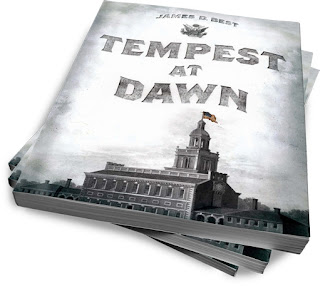 |
| The real story of our nation's founding. |
 Many also harbor misunderstandings about how the main body
of the Constitution addressed slavery and voting rights. Despite obvious
shortcomings, by 1775, the American colonies were the most democratic places on
earth. In Britain, voting rights were far more limited than in the colonies. Less
than ten percent of men could vote in Britain, and those who could vote were
selected by local nobility. A far larger segment of men voted in the colonies
and the requirements were set by law, not officials. Voting rights traced back
to the earliest history of the colonies. Within days of landing in Jamestown,
for instance, the first colonists elected an executive officer. Only six men
were allowed to vote in this embryonic colony, but from that moment forward,
colonists expanded the right to vote to broader segments of the population.
Many also harbor misunderstandings about how the main body
of the Constitution addressed slavery and voting rights. Despite obvious
shortcomings, by 1775, the American colonies were the most democratic places on
earth. In Britain, voting rights were far more limited than in the colonies. Less
than ten percent of men could vote in Britain, and those who could vote were
selected by local nobility. A far larger segment of men voted in the colonies
and the requirements were set by law, not officials. Voting rights traced back
to the earliest history of the colonies. Within days of landing in Jamestown,
for instance, the first colonists elected an executive officer. Only six men
were allowed to vote in this embryonic colony, but from that moment forward,
colonists expanded the right to vote to broader segments of the population. 