Showing posts with label csa. Show all posts

Wednesday, January 10, 2024

Confederates in the Attic

Confederates in the Attic

Dispatches from the Unfinished Civil War 

Tony Horwitz
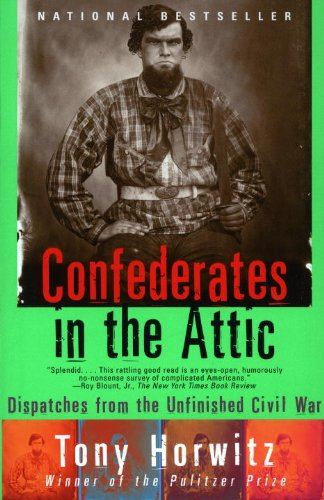


Confederates in the Attic is a present day (1998) memoir of a Civil War tour. The book is appropriately titled. When you rummage around an attic, you find all kinds of junk. Junk that’s past it’s prime, odd reminders of bygone days, nostalgic twaddle, and utter fantasies. Tony Horwitz, a Pulitzer Prize-winning journalist, finds all of these and more. Unfortunately, he spends too much time in the shadowy recesses of his metaphorical attic.

The encountered characters and whimsical writing make the tour fascinating, but there’s not much substance added to lore of this bloody conflict. That’s not a criticism because the book’s intent is to investigate lingering sentiments, not to uncover facts or artifacts. The narrative actually references a lot of Civil War history and I found no errors of note. (The characters in this memoir would prefer the War Between the States, or even better, the War of Northern Aggression.)

Horwitz lives in Virginia, so he’s not exactly a Yankee peeking into odd corners to discover residue views on the war. Sometimes, however, Horwitz’s Northern education (Brown and Columbia), slants his perspective, especially when it comes to race. I found his condescending depiction of Southern racism off-putting, especially since in 1998, I lived in Boston, which was far more segregated than any Southern city. Horwitz described Atlanta as a bland and boring place unconcerned with the Civil War. My experience is that Atlanta is more representative of Southern attitudes than those portrayed by the enthusiasts for the “Lost Cause.”

Tuesday, April 11, 2023

Lincoln Book Review: The Trent Affair


The Trent Affair: The Diplomatic Incident that Nearly Brought Great Britain into the American Civil War

The Trent Affair claims historians pay the Affair short shrift, then promises to deliver new revelations about this diplomatic incident. The books primary value is quoting first source letters, newspaper articles, and official documentation. It is always useful to read first source material, but those presented do not provide a different perspective than historians have depicted. Granted, historians gloss over the nuts and bolts of the Affair, but it’s because the issue was resolved before it could impact the course of the conflict.

What if the Trent Affair hadn’t been agreeably settled. If Great Britain had entered the war on the Confederacy’s side, it was likely that the South would have won. That would have made the Trent Affair a huge deal. Jefferson Davis’s top diplomatic priority was to drag a European power into combat. Abraham Lincoln’s top diplomatic priority was to deny the Confederate States of America recognition by European powers. This book did not provide additional insights on how Lincoln outsmarted Davis. As you study the Affair, there are hints of backroom bartering but no evidence. When desired, Lincoln was fairly astute at maneuvering without leaving fingerprints.

This is an odd little book with poor transitions and scant narrative about quoted material. The photographs of the major participants are well known. In the end, the book added little understanding to this diplomatic fiasco. A pity because handled differently, the Trent Affair could have been the linchpin to the entire conflict.


Saturday, April 1, 2023

Lincoln Book Review: The Shut Mouth Society


The Shut Mouth Society is my own Lincoln book. This modern day thriller is a typical chase novel à la Robert Ludlum. The Ludlum formula for this genre has a man and woman oddly meet to be accused of a crime and then chased by good guys and bad guys until they save themselves by unraveling a mystery that threatens social order. In my book, the mystery is a secret society formed after the Civil War that threatens to take control Mexico. The chase is launched when a small town police chief and renowned professor are asked to assess the validity of a pre-presidential document in Lincoln hand. Abe Lincoln is interwoven throughout the story as they must examine his life and motivations to solve the mystery.

I had done an enormous amount of research on Lincoln to craft an exciting story that was also historically accurate. These are book reviews but I’m too biased to rate The Shut Mouth Society as a work of fiction. (However, 405 Amazon readers have given it an average rating of 4.3 and the book was a finalist is the APA Glyph Awards for Best Novel.) This reading was to revisit my Lincoln research for my historical novel Maelstrom. I found no substantive errors. (However, if a set of dialogue begins with something like, “Some historians believe,” then what follows is not necessarily true. It only means that some credentialed authors believe it true. I believe I wrote the story in a manner where a reader will have no difficulty separating historical fact from speculation.)

All of that said, I believe The Shut Mouth Society is a fun way for readers to enjoy a rousing story and obtain a better understanding of our sixteenth president.


Wednesday, March 16, 2022

The Truth of the War Conspiracy of 1861 by H W Johnstone


This booklet was published in 1921 by a veteran of the Civil War. The author’s intent is to advocate for The Cause and expose the “truth.” I’ve read several modern-day defenses of The Cause, but I wanted to get the perspective of someone closer in time to the conflict. A participant was even better, although Johnstone served for only an unexplained eight months. Unfortunately, time and participation provided few novel insights. I shouldn't have been surprised because years earlier Jefferson Davis had articulated the dogma of The Cause in his two histories of the Confederated States of America.

Johnstone presents the case that a duplicitous President Lincoln started the war by reinforcing Forts Sumter and Pickens, the last Union military presence in the seceded states. First, the duplicitous part. In his inaugural, Lincoln said, “The power confided to me will be used to hold, occupy, and possess the property and places belonging to the Government.” All other military installations had been confiscated prior to his inaugural, so he could only have been speaking about Sumter and Pickens.

What act started the war? Secession of seven states in response to the election of a Republican or Lincoln taking office despite threats of assassination? The confiscation of Federal property under threat of physical attack or denial of weapons, munitions, and battlements to a belligerent? Does relentless bombardment of Sumter constitute an act of war or providing food and water to those starving soldiers? The South had been threatening war ever since a split Democratic Party guaranteed the election of a Republican. They made good on their threats.

Despite the reality of the situation, Johnstone paints Lincoln as despotic for not surrendering to the demands of the seceded states. Prior to inauguration, did he distance himself from Seward and the Peace Conference? He did. In his mind, he did not yet have authority to intervene. Did he dispatch war ships to accompanying the resupply ships? He did, but he sent the South Carolina governor a message that he would peaceably resupply the fort unless met with resistance. To deal with resistance if encountered, he needed naval war ships. Did Lincoln maneuver to put Jefferson Davis in a box? He did. And he did this successfully because he was a better politician.

Johnstone was right about one thing. The war could have been avoided if Lincoln had acceded to every demand. Forever. 

Since the Constitutional Convention, slave states had been demanding that the North acquiescence to their peculiar institution or they would bolt. Bolt they did. Not over slavery in their own states, but because the Republican platform vowed to use federal powers to stop any further expansion of slavery.

Perhaps the war was inevitable. Once the South was independent, new demands of their neighbor would never cease. Sooner or later, there would be one demand too many.

Saturday, February 12, 2022

Bitterly Divided: The South's Inner Civil War


Bitterly Divided by David Williams makes sense. If the political establishment in a bunch of states decided to secede, there would obviously be inhabitants who retained a stronger loyalty to the United States of America. After all, they had been proud U.S. citizens for their entire life. I bet you saw a but coming. The but is that although Williams presents voluminous evidence of insurgence within the CSA, it is not clear that it materially hampered the Confederacy’s war efforts until the last year or so.

The catchphrase, ‘rich man’s war, poor man’s fight,’ may have been a truism, but Southern men continued to fight until victory became hopeless or they received news from home that their families were starving. Williams contends that slaveholders masterminded the war but, for the most part, non-slave holders fought it. Three-fourths of southern whites owned no slaves, so arithmetic alone proves Williams correct. 

Statistical data shows that by every economic measure, the North far outperformed the South. The only area where the South exceeded the North was in income disparity. Williams writes: “On the Civil War’s eve, nearly half the South’s personal income went to just over a thousand families.” The rich were very rich and few in number. The uneducated poor white were as omnipresent as slaves. 

At the start of the war, a recruitment broadside oddly read, “To arms! Our Southern soil must be defended. We must not stop to ask who brought about the war, who is at fault, but let us go and do battle… and then settle the question who is to blame.”

Today, that poster may not appear convincing, but decades of Democrat propaganda had bred hatred for Yankees and instilled fear of “Black Republicans.” Repeatedly, poor whites were told that freed slaves would “come into competition, associate with them and their children as equals—be allowed to testify in court against them—sit on juries with them, march to the ballot box by their sides, and participate in the choice of their rulers—claim social equality with them—and ask the hands of their children in marriage.”

When the conflict began, relentless propaganda claimed the North had invaded the South, but the Confederate Army was a reality well before Manassas. Prior to that opening battle, the North had only resisted Confederate confiscation of United States property in the seceded states. Still, men believed that they went to fight an enemy that had violated the hallowed land of the South. Why?

Jefferson Davis believed slavery gave every white person an elevated position in society independent of their lot in life. Were the poor fighting to retain this artificially elevated position? Not sure, but I’ll keep reading to find the answer.

(This is a research book for Maelstrom, a sequel to Tempest at Dawn.)

Tuesday, December 21, 2021

A Short History of the Confederate States of America


After the Civil War, Jefferson Davis spent two years in prison without trial. He was released on bail and a year and a half later, the government finally dropped the treason charges against him. In 1877 he retired to Beauvoir, where he wrote, The Rise and Fall of the Confederate Government. This was a two-volume tome of over 1,500 pages. I did not read this book. I tried, but I kept following asleep. Luckily, ten years later, Davis wrote A Short History of the Confederate States of America. Roughly one-third in length, “A Short History” covers the same ground and is more readable.

Davis writing style is clear for modern readers, but I would recommend a good understanding of the war to provide context for his narrative. That said, for a thorough understanding of a major historical event, it always best to get the story from the horse’s mouth. The Davis perspective may be biased, but those perspectives did not change between the war and the writing of his memoir. That consistency makes this book valuable for understanding the motivations for war.

Davis extols victories and offers strained excuses for errors and failures. In Davis’ mind, nothing was his fault, the Confederacy was always honorable, the Union always vile. For those not imbued with The Cause mythology, this heavy-handed prejudice can be off-putting, but I found it helps understand the ethos of the period.

Most history books are written by winners. If you don’t study the losers, then you have an incomplete picture. An example would be the hallowed Federalist Papers. There is a collection of opposition opinion pieces called the Anti-Federalist Papers. I suggest reading both and I highly recommend Jefferson Davis’ A Short History of the Confederate States of America.

(This is a research book for Maelstrom, a sequel to Tempest at Dawn.)