 |
| The story of the greatest rivalry in American History. Buy at Amazon |
Dixie Betrayed, How the South Really Lost The Civil War by Davis J. Eicher

The last words of Eicher’s book are “Jefferson Davis had
lost his power as Confederate president — but not before the whole cause of the
Confederacy was lost. Dixie was Betrayed.”
The title and these final words betray the worth of this
book. Nearly twenty thousand books have been written about Lincoln and almost a
hundred thousand about the Civil War. Less than an estimated twenty percent of
these were written from a Confederate perspective and many of those were Lost
Cause screeds. Since the Confederacy lost, official documents were often
destroyed which requires a historian to rely on sources like newspapers,
letters, and memoirs—and these are not nearly as well organized and indexed as
Union sources. This may partially account for why relatively few Confederate
histories have been published.
Dixie Betrayed is a solid history of the Confederacy
and does not attempt to propagate the Lost Cause myths. Eicher explains how the
South lost, but betrayal played no role in it. The absence of an industrial
base, limited manpower, naive political leadership, and a flawed constitution
were the culprits.
The betrayal theme likely originated from an editorial meeting aimed at boosting sales, and it may have been effective for the launch. However, now Eicher’s book wears the title like an albatross, and it is perhaps overlooked by those seeking an erudite history of the Confederate States of America.
To understand the Civil War period, it is necessary to study
the war from both sides. Dixie Betrayed by Davis J. Eicher provides the view from the Confederate side.

Like A Meteor Blazing Brightly: The Short but Controversial Life of Colonel Ulric Dahlgren
These Ulric Dahlgren biographies present the Union and Confederate views of the Dahlgren Affair.
Here is the gist of the “Affair.” In February of 1864, a Union
cavalry detachment raided Richmond in the hope of releasing imprisoned soldiers
captured by the Confederacy. Colonel Ulric Dahlgren led a major arm of the
assault. The raid was unsuccessful, and Dahlgren was killed in an ambush. Papers
were found on Dahlgren’s body that ordered the raiding party to murder
Jefferson Davis and his cabinet. The Union claimed the papers were forgeries while
the Confederacy insisted they were genuine. At the time, the Dahlgren Affair
became a cause célèbre. The authenticity of the papers remains unresolved.
Ulric’s father, Admiral Dahlgren, insisted that the papers
were forgeries and his son would never have taken part in an assassination plot. The
memoir, written by the admiral in 1872, makes the case for the papers being
forged.
Eric J. Wittenberg's 2015 biography, Like A Meteor Blazing Brightly: The Short but Controversial Life of
Colonel Ulric Dahlgren, argues for the authenticity of the papers. The book
details Ulric’s brief life, focusing primarily on the Dahlgren Affair.
If you enjoy the Civil War or unsolved mysteries, read both
books and decide for yourself.

Memoirs of General W. T. Sherman by William T Sherman
In turns fascinating and boring. General Sherman wrote a
valuable memoir for historians, but too much minutia for the casual Civil War
buff. Sherman includes innumerable orders and other correspondence and
describes his entire command structure every time there is a significant change
or battle. Although historians, especially military historians, will find this
invaluable, it can often be dull reading. Sherman frequently allows these
documents to tell the story without presenting a description in his narrative.
This means the reader must at least review the correspondence to gain a sense
of the events.
Disappointedly, Sherman seldom shares his opinions or even
thoughts about significant issues. It’s sort of the Jack Webb version of his
life. When Sherman does express an opinion, it’s pure gold, especially the
chapter when he recounts what he believes are the military lessons from the
Civil War.

I last read The Killer Angels four decades ago. I liked it the first time, but really grew to appreciate it with this reading. Great story, well written, and enlightening. My project, Maelstrom, is also a historical novel that alternates between Union and Confederate viewpoints, so I appreciated the difficulty of portraying events in an entertaining manner while remaining historically accurate.
The advantage of historical novelizations is that they can bring characters to life and allow the reader to feel like they were present when events unfolded. Novels are first and foremost stories, and stories must move. History has a way of happening in a haphazard fashion that hinders storytelling. The difficulty is to maintain good pacing while remaining faithful to the historical presentation. In this reading I could lift myself above the story and admire the craft.
Sharra does an excellent job and
deserved the Pulitzer Prize he won for The Killer Angels.
Confederates in the Attic
Dispatches from the Unfinished Civil War
Tony Horwitz
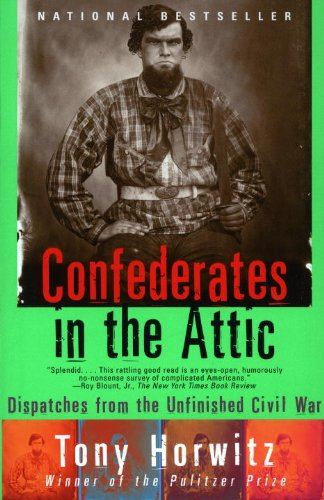
Confederates in the Attic is a present day (1998) memoir of a Civil War tour. The book is appropriately titled. When you rummage around an attic, you find all kinds of junk. Junk that’s past it’s prime, odd reminders of bygone days, nostalgic twaddle, and utter fantasies. Tony Horwitz, a Pulitzer Prize-winning journalist, finds all of these and more. Unfortunately, he spends too much time in the shadowy recesses of his metaphorical attic.
The encountered characters and whimsical writing make the
tour fascinating, but there’s not much substance added to lore of this bloody conflict. That’s not a criticism because the book’s intent is to
investigate lingering sentiments, not to uncover facts or artifacts.
The narrative actually references a lot of Civil War history and I found no
errors of note.
Horwitz lives in Virginia, so he’s not exactly a Yankee peeking
into odd corners to discover residue views on the war. Sometimes, however, Horwitz’s Northern
education (Brown and Columbia), slants his perspective,
especially when it comes to race. I found his condescending depiction of
Southern racism off-putting, especially since in 1998, I lived in Boston, which
was far more segregated than any Southern city. Horwitz described Atlanta as
a bland and boring place unconcerned with the Civil War. My experience is that
Atlanta is more representative of Southern attitudes than those portrayed by the enthusiasts for the “Lost Cause.”

Thomas B. Allen & Rodger MacBride
Long title and a bit of a misnomer because this book also deals with the Confederate States of America's use of technology. Granted, the Confederacy was limited by their scarce industrial capability, but they focused what they had on their navy, including the first ironclad in combat and the first submarine. Both were effective when let out of the barn, but neither lasted much beyond their first engagement. That’s the way it goes with military innovation; failures often precede a workable design.
Most people view the American Civil War as a series of bloody battles fought with muskets and cannons. It all looks so backward from a modern perspective. In truth, the American Civil War changed warfare dramatically through the use of technology. Prior to the Civil War, Napoleon defined combat strategy and almost every senior officer on either side of the Civil War received their education at West Point which was steeped in the Napoleonic principles of warfare. These principles did not last long into the war. Dahlberg cannons, rifled cannon, rifled shoulder weapons, repeating rifles, repeating pistols, trench warfare, instant telegraph communication, railroads, steam-powered warships, iron clads, turret mounted cannons, submarines, primitive but effective stealth techniques, and ammunition advances made Napoleonic strategies as obsolete as battleships in WWII. These advances in technology were so important that every world power sent military observers to watch how both Union and Rebel forces adjusted to the new weapons.
 |
| First submarine |
Mr. Lincoln’s High-Tech War is a short, fast moving book that concentrates on a single aspect of the war. It is filled with illustrations and sidebars which keeps the reader’s interest and help the narrative run smoothly. This National Geographic book is a well-written book with high production values. Mr. Lincoln’s High-Tech War is supposedly targeted at middle-school age children, but anyone interested in the Civil War or the technology of warfare will find it informative.

A World on Fire: Britain's Crucial Role in the American Civil War

There are plenty of history books on the Civil War, but few
books that convey another country’s perspective. Amanda Foreman has done
history buffs a service by providing a British perspective of our great
conflict. Foreman also provides fascinating details about spy operations in Canada
and some information about French, Irish, and German participation as diplomats, soldiers, and observers. Not quite a
world on fire, but it’s eye opening to learn how much our civil war affected
other nations.
The greatest contribution of A World on Fire is additional
insight into the issue of British and French recognition of the Confederate
States of America. This was the biggest political battle of the war and Abraham
Lincoln beat Jefferson Davis on what many believed should have been an easy Confederate
victory. If recognition had come, the South probably would have achieved
independence.
A World on Fire is a dazzling research effort with
most of the narrative driven from personal letters, diaries, and official
documents. Unfortunately, too much of this research made it into the book. The large tome sometimes takes a deep dive into a British person’s
experience for no apparent reason other than that individual kept a good diary.
The perspective of a common soldier or low level officer can be valuable and
interesting, but it felt out of place in a book purportedly about foreign perspectives
of the war because a soldier’s experience was similar independent of their
nationality. The books also jumps around in a manner that seems unnatural, with
characters resurfacing after a long absence without any reminders of who they
were.
In all, A World on Fire is a rare glimpse of the American
Civil War from a different perspective. Considering the number of books on the
subject, that is an amazing accomplishment in and of itself.

The Radical and the Republican
Frederick Douglass, Abraham Lincoln, and the Triumph of Antislavery
Politics
by James Oakes
Several books study the relationship between Abraham Lincoln and Frederick Douglass. Brian Kilmeade’s The President and the Freedom Fighter was published more recently, but since I have not read Kilmeade’s treatment, I am unable to compare them.
The Radical and the Republican is a balanced view of a pair of critically important men in American history. Since Lincoln and Douglass did not meet until nearly two and a half years into Lincoln’s first administration, the majority of the book reports their personal history and views separately, as if they were on parallel tracks toward the same goals. Except the tracks were not parallel. Although you could not prove it by Lincoln’s utterances, I believe their slavery goals were the same, but the strategy and tactics were so wide apart that Douglass doubted that Lincoln was an ally in his cause.
I think the following two quotes from the book succinctly summarize how Lincoln crafted his strategy. The first is from Lincoln and the second is an assessment of his political talent by James Oates.
“With public
sentiment nothing can fail; without it nothing can succeed. Consequently, he
who molds public sentiment, goes deeper than he who enacts statutes or
pronounces decisions. He makes statutes and decisions possible or impossible to
be executed.” Abraham Lincoln
“He was so in
tune with the movement of public opinion that he could calibrate his own moves
with astonishing skill.” James Oats
For those with an interest in the history of American slavery,
The Radical and the Republican tells the story of how these two men overcame
the huge obstacles that stood in the way of emancipation. Even when they weren't in partnership, they were partners. Partners who eventually became fast friends.
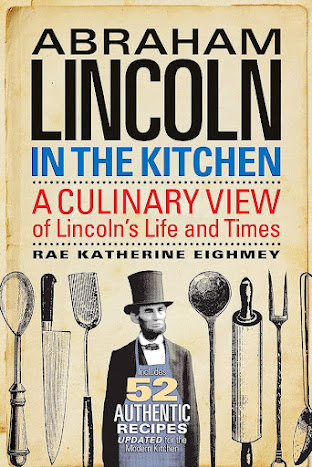
Abraham Lincoln in the Kitchen, A Culinary View of Lincoln’s Life and Times
Rae Katherine Eighmey
The novelization of a key era must read like a story and stories include details about how the protagonists and antagonist lived. A writer can go overboard on food, lodging, transportation, clothing, etc. but a sprinkling of these details enlivens the narrative. Luckily, the description of ordinary people’s lives became an academic trend, and when I wrote Tempest at Dawn, I found countless books on the day to day life of our Revolutionary forebears. For some reason, descriptions of culture and daily routines are harder to find for the Civil War period. Actually, books about common soldiers are abundant, but I’m writing a novel about the politics of the war, not the battles.
Abraham Lincoln in the Kitchen helped fill the void. I’m not a
cook, so I merely scanned the fifty-five recipes, but these are surrounded by
excellent descriptions everyday life, especially food procurement, preparation,
and consumption. Each chapter covers a specific historical period and Eighmey
does a good job of sleuthing out how Lincoln lived and accurate period recipes.
I’m unqualified to review the recipes, but I have read enough period history to say that Eighmey did her homework, which gave me confidence to rely on her descriptions on mundane daily activities.
The subtitle, A Culinary View of Lincoln’s Life and Times, is more accurate than the main title, Abraham Lincoln in the Kitchen. Eighmey does list a couple of references of Abe helping out in the kitchen, but this did not appear to be frequent. Most historians say that Lincoln was disinterested in food and ate lightly. My greatest insight from this book is that this common wisdom is only partially true. Lincoln enjoyed being around people and he also enjoyed being the center of attention. Food is frequently prevalent when people gather, but telling stories without a mouthful hampers chowing down. In the right setting, it appears Lincoln had a healthy appetite, but when distracted by thoughts or an audience, he could neglect to fuel his body. Another insight is that Mary was much more of a homemaker than generally conveyed. Reading about their pre-presidential life made me think their marriage was stronger than I had previously assumed.

Abraham Lincoln and The Second American Revolution by James M. McPherson
This book is a collection of seven essays on the Civil War. Originally,
these essays were lecture notes. They are well written and thoughtful. The
common theme is that the Civil War was a second revolution because it resulted
in revolutionary transformations of the country and was accompanied by a
counter-revolution a couple decades after Appomattox. Each essay covers a
single premise and can be read separately.
Slavery divided the nation in 1787 and severed the nation in
1860. Many have said that the Civil War settled the key issue kicked down the
road by the Constitutional Convention. Did the Civil War finish the Founders’
work or was it in and of itself revolutionary? Read Abraham Lincoln and The
Second American Revolution and decide for yourself.
Ending slavery in the United States was horrendously
difficult. It took a four year war with about 620,000 deaths. The politics were
byzantine and the warfare brutal. Reunification was even more ferocious, and absent
Lincoln, the backsliding undid much of the accomplishment.
In the end, I found this to be a sad book.

The Trent Affair claims historians pay the Affair short shrift, then promises to deliver new revelations about this diplomatic incident. The books primary value is quoting first source letters, newspaper articles, and official documentation. It is always useful to read first source material, but those presented do not provide a different perspective than historians have depicted. Granted, historians gloss over the nuts and bolts of the Affair, but it’s because the issue was resolved before it could impact the course of the conflict.
What if the Trent Affair hadn’t been agreeably settled. If
Great Britain had entered the war on the Confederacy’s side, it was likely that
the South would have won. That would have made the Trent Affair a huge deal. Jefferson
Davis’s top diplomatic priority was to drag a European power into combat.
Abraham Lincoln’s top diplomatic priority was to deny the Confederate States of
America recognition by European powers. This book did not provide additional
insights on how Lincoln outsmarted Davis. As you study the Affair, there are
hints of backroom bartering but no evidence. When desired, Lincoln was fairly astute
at maneuvering without leaving fingerprints.
This is an odd little book with poor transitions and scant narrative
about quoted material. The photographs of the major participants are well known.
In the end, the book added little understanding to this diplomatic fiasco. A
pity because handled differently, the Trent Affair could have been the linchpin
to the entire conflict.

A lot happened between July 9th and the 12th in 1864. Marc Leepson has made this short period of the Civil War the focus
of his book Desperate Engagement: How a Little-Known Civil War Battle
Saved Washington D. C., and Changed American History.
In the end, the battle changes little other than perhaps delaying the end of the war. General Grant continued his stranglehold on the Confederate Army surrounding Richmond until Lee surrendered at Appomattox. Nonetheless, if the Hail Mary pass had been completed and General Jubal Early had sacked Washington, we might be all speaking with a Southern accent.
It was
close. Heart-stopping close.
The risky moves and countermoves, potential payoff, and unbridled
heroism on both sides should have made this an exciting book. The Battle of
Monocacy and attempted siege are nicely covered in about four or five chapters
with the remaining chapters filled mostly with letters and memoirs of the
participants, asides, or research factoids. Civil War buffs should find even
the trivia interesting, but a casual reader might view much of this text as fill.
