Showing posts with label political history. Show all posts

Sunday, July 16, 2023

Book Review: The Radical and the Republican by James Oates


The Radical and the Republican

Frederick Douglass, Abraham Lincoln, and the Triumph of Antislavery Politics                                

by James Oakes

Several books study the relationship between Abraham Lincoln and Frederick Douglass. Brian Kilmeade’s The President and the Freedom Fighter was published more recently, but since I have not read Kilmeade’s treatment, I am unable to compare them. 

The Radical and the Republican is a balanced view of a pair of critically important men in American history. Since Lincoln and Douglass did not meet until nearly two and a half years into Lincoln’s first administration, the majority of the book reports their personal history and views separately, as if they were on parallel tracks toward the same goals. Except the tracks were not parallel. Although you could not prove it by Lincoln’s utterances, I believe their slavery goals were the same, but the strategy and tactics were so wide apart that Douglass doubted that Lincoln was an ally in his cause.

I think the following two quotes from the book succinctly summarize how Lincoln crafted his strategy. The first is from Lincoln and the second is an assessment of his political talent by James Oates.


“With public sentiment nothing can fail; without it nothing can succeed. Consequently, he who molds public sentiment, goes deeper than he who enacts statutes or pronounces decisions. He makes statutes and decisions possible or impossible to be executed.” Abraham Lincoln


“He was so in tune with the movement of public opinion that he could calibrate his own moves with astonishing skill.” James Oats


For those with an interest in the history of American slavery, The Radical and the Republican tells the story of how these two men overcame the huge obstacles that stood in the way of emancipation. Even when they weren't in partnership, they were partners. Partners who eventually became fast friends.

Monday, June 26, 2023

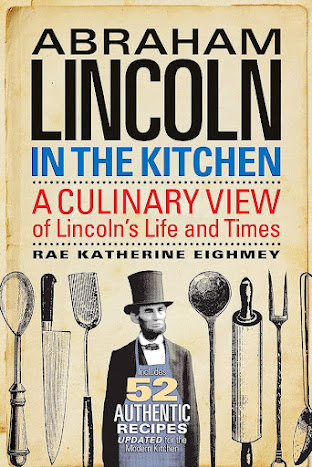
Abraham Lincoln in the Kitchen


Abraham Lincoln in the Kitchen, A Culinary View of Lincoln’s Life and Times

Rae Katherine Eighmey


The novelization of a key era must read like a story and stories include details about how the protagonists and antagonist lived. A writer can go overboard on food, lodging, transportation, clothing, etc. but a sprinkling of these details enlivens the narrative. Luckily, the description of ordinary people’s lives became an academic trend, and when I wrote Tempest at Dawn, I found countless books on the day to day life of our Revolutionary forebears. For some reason, descriptions of culture and daily routines are harder to find for the Civil War period. Actually, books about common soldiers are abundant, but I’m writing a novel about the politics of the war, not the battles.

Abraham Lincoln in the Kitchen helped fill the void. I’m not a cook, so I merely scanned the fifty-five recipes, but these are surrounded by excellent descriptions everyday life, especially food procurement, preparation, and consumption. Each chapter covers a specific historical period and Eighmey does a good job of sleuthing out how Lincoln lived and accurate period recipes.

I’m unqualified to review the recipes, but I have read enough period history to say that Eighmey did her homework, which gave me confidence to rely on her descriptions on mundane daily activities.

The subtitle, A Culinary View of Lincoln’s Life and Times, is more accurate than the main title, Abraham Lincoln in the Kitchen. Eighmey does list a couple of references of Abe helping out in the kitchen, but this did not appear to be frequent. Most historians say that Lincoln was disinterested in food and ate lightly. My greatest insight from this book is that this common wisdom is only partially true. Lincoln enjoyed being around people and he also enjoyed being the center of attention. Food is frequently prevalent when people gather, but telling stories without a mouthful hampers chowing down. In the right setting, it appears Lincoln had a healthy appetite, but when distracted by thoughts or an audience, he could neglect to fuel his body. Another insight is that Mary was much more of a homemaker than generally conveyed. Reading about their pre-presidential life made me think their marriage was stronger than I had previously assumed.