 |
| The story of the greatest rivalry in American History. Buy at Amazon |

Book 2 in the American Exceptionalism Series
(Ebook, Hardcover and paperback)
“I enjoyed this.”
Harold Holzer, Lincoln Prize winner and Chair of The Lincoln Forum
"See Lincoln as you've never seen him before as he navigates the maelstrom of the Civil War."
Larry Schweikart, NYTimes #1 Bestselling author
Maelstrom tells the story of the greatest rivalry in American history. Abraham Lincoln and Jefferson Davis led their nations in a must-win fight, and Maelstrom shows how each dealt with the same issues, countered the other’s moves, led their respective governments, and used their political powers to sway the outcome.
Read the first chapter free HERE.

Like A Meteor Blazing Brightly: The Short but Controversial Life of Colonel Ulric Dahlgren
These Ulric Dahlgren biographies present the Union and Confederate views of the Dahlgren Affair.
Here is the gist of the “Affair.” In February of 1864, a Union
cavalry detachment raided Richmond in the hope of releasing imprisoned soldiers
captured by the Confederacy. Colonel Ulric Dahlgren led a major arm of the
assault. The raid was unsuccessful, and Dahlgren was killed in an ambush. Papers
were found on Dahlgren’s body that ordered the raiding party to murder
Jefferson Davis and his cabinet. The Union claimed the papers were forgeries while
the Confederacy insisted they were genuine. At the time, the Dahlgren Affair
became a cause célèbre. The authenticity of the papers remains unresolved.
Ulric’s father, Admiral Dahlgren, insisted that the papers
were forgeries and his son would never have taken part in an assassination plot. The
memoir, written by the admiral in 1872, makes the case for the papers being
forged.
Eric J. Wittenberg's 2015 biography, Like A Meteor Blazing Brightly: The Short but Controversial Life of
Colonel Ulric Dahlgren, argues for the authenticity of the papers. The book
details Ulric’s brief life, focusing primarily on the Dahlgren Affair.
If you enjoy the Civil War or unsolved mysteries, read both
books and decide for yourself.

Memoirs of General W. T. Sherman by William T Sherman
In turns fascinating and boring. General Sherman wrote a
valuable memoir for historians, but too much minutia for the casual Civil War
buff. Sherman includes innumerable orders and other correspondence and
describes his entire command structure every time there is a significant change
or battle. Although historians, especially military historians, will find this
invaluable, it can often be dull reading. Sherman frequently allows these
documents to tell the story without presenting a description in his narrative.
This means the reader must at least review the correspondence to gain a sense
of the events.
Disappointedly, Sherman seldom shares his opinions or even
thoughts about significant issues. It’s sort of the Jack Webb version of his
life. When Sherman does express an opinion, it’s pure gold, especially the
chapter when he recounts what he believes are the military lessons from the
Civil War.

Lincoln’s Sanctuary looks at Lincoln from a new vantage point. With thousands upon thousands of Lincoln books, this seems like quite a
feat but Pinsker pulls it off. Lincoln’s Sanctuary explores Abraham
Lincoln’s time at the Soldiers’ Home, a cottage in the heights of Washington
that served much like Camp David does today.
From 1862 to 1864, Lincoln and his family spent summers at
the cottage to escape the heat and in-city pressures. Pinsker, a
historian, uses primary sources to paint a vivid picture of Lincoln’s personal
and political life during this period. The book connects the cottage to key
wartime events, including the Emancipation Proclamation, the firing of General
McClellan, and Lincoln’s evolving public image.
Lincoln buffs looking for a peek into Lincoln’s private life
will find this book interesting.

Some historians have criticized the accuracy of Killing Lincoln. I disagree. The book does not purport to be an academic treatment and appears accurate when describing relevant events and details. My only serious concern is that O’Reilly included asides that Secretary of War Edwin Stanton might have had a hand in the intrigue. I find Stanton’s involvement dubious and the inclusion unnecessary.
It may surprise many to discover the extent of the conspiracy, which went beyond Lincoln to include attempted assassinations of the vice president and secretary of state. Bad people do conspire to do bad things.
There are so many Lincoln books that authors have begun to address a single event in his life. Considering the title, I don’t believe I’m revealing a spoiler to say that this book is about Lincoln's death. Killing Lincoln does a good job of describing the assassination in a readable style that makes the book hard to put down.
If you are interested in Lincoln, conspiracies, or American history, you’ll enjoy this book.

Thomas B. Allen & Rodger MacBride
Long title and a bit of a misnomer because this book also deals with the Confederate States of America's use of technology. Granted, the Confederacy was limited by their scarce industrial capability, but they focused what they had on their navy, including the first ironclad in combat and the first submarine. Both were effective when let out of the barn, but neither lasted much beyond their first engagement. That’s the way it goes with military innovation; failures often precede a workable design.
Most people view the American Civil War as a series of bloody battles fought with muskets and cannons. It all looks so backward from a modern perspective. In truth, the American Civil War changed warfare dramatically through the use of technology. Prior to the Civil War, Napoleon defined combat strategy and almost every senior officer on either side of the Civil War received their education at West Point which was steeped in the Napoleonic principles of warfare. These principles did not last long into the war. Dahlberg cannons, rifled cannon, rifled shoulder weapons, repeating rifles, repeating pistols, trench warfare, instant telegraph communication, railroads, steam-powered warships, iron clads, turret mounted cannons, submarines, primitive but effective stealth techniques, and ammunition advances made Napoleonic strategies as obsolete as battleships in WWII. These advances in technology were so important that every world power sent military observers to watch how both Union and Rebel forces adjusted to the new weapons.
 |
| First submarine |
Mr. Lincoln’s High-Tech War is a short, fast moving book that concentrates on a single aspect of the war. It is filled with illustrations and sidebars which keeps the reader’s interest and help the narrative run smoothly. This National Geographic book is a well-written book with high production values. Mr. Lincoln’s High-Tech War is supposedly targeted at middle-school age children, but anyone interested in the Civil War or the technology of warfare will find it informative.

A World on Fire: Britain's Crucial Role in the American Civil War

There are plenty of history books on the Civil War, but few
books that convey another country’s perspective. Amanda Foreman has done
history buffs a service by providing a British perspective of our great
conflict. Foreman also provides fascinating details about spy operations in Canada
and some information about French, Irish, and German participation as diplomats, soldiers, and observers. Not quite a
world on fire, but it’s eye opening to learn how much our civil war affected
other nations.
The greatest contribution of A World on Fire is additional
insight into the issue of British and French recognition of the Confederate
States of America. This was the biggest political battle of the war and Abraham
Lincoln beat Jefferson Davis on what many believed should have been an easy Confederate
victory. If recognition had come, the South probably would have achieved
independence.
A World on Fire is a dazzling research effort with
most of the narrative driven from personal letters, diaries, and official
documents. Unfortunately, too much of this research made it into the book. The large tome sometimes takes a deep dive into a British person’s
experience for no apparent reason other than that individual kept a good diary.
The perspective of a common soldier or low level officer can be valuable and
interesting, but it felt out of place in a book purportedly about foreign perspectives
of the war because a soldier’s experience was similar independent of their
nationality. The books also jumps around in a manner that seems unnatural, with
characters resurfacing after a long absence without any reminders of who they
were.
In all, A World on Fire is a rare glimpse of the American
Civil War from a different perspective. Considering the number of books on the
subject, that is an amazing accomplishment in and of itself.

Lincoln at Gettysburg, The Words that Remade America by Garry Wills
Lincoln at Copper Union, The Speech that Made Abraham Lincoln President by Harold Holzer
Each of these books covers a single important speech by Abraham Lincoln. The Cooper Union Address set a course for his presidential quest and the famous Gettysburg Address reset the course of the war. The speeches were delivered about three and a half years apart. The Cooper Union Address was given in New York City on February 27, 1860, prior to Lincoln’s nomination as the Republican presidential candidate. The Gettysburg Address was delivered on November 19, 1863, about four months after the battle.
Both books are highly readable and well researched. Wills’ won the Pulitzer Prize with Lincoln at Gettysburg and Holzer’s won the Lincoln Prize with his book about the Cooper Union Address.
It might seem hard to write an entire book about a single speech, but Wills and Holzer had no difficulty filling the pages. More important, readers will have no problem gobbling them up. The books are kept interesting by providing context, motivations, lifestyle, period travel, and supposed Lincoln collaboration with others in his political circle. I say supposed because Lincoln sought out advice and gave everyone the impression that he valued their suggestions and edits, however he used these changes sparingly. To a degree, this was a Lincoln technique to build support for an address prior to delivering it.
The pair of speeches have many similarities. Both were high-minded. Both had an important objective. Both advanced the abolition of slavery. Both were crafted to be heard and read. Both surprised their audiences. Both were memorable. They also had differences, the greatest being length. The Cooper Union Address was nearly an hour and at over seven thousand words, one of Lincoln’s longest speeches, while the Gettysburg address took only two minutes to deliver and contained a mere 272 words.
If you are interested in Abraham Lincoln or how to craft a great speech, these books are indispensable. They are well written, thoroughly researched, and fascinating reads.

The Radical and the Republican
Frederick Douglass, Abraham Lincoln, and the Triumph of Antislavery
Politics
by James Oakes
Several books study the relationship between Abraham Lincoln and Frederick Douglass. Brian Kilmeade’s The President and the Freedom Fighter was published more recently, but since I have not read Kilmeade’s treatment, I am unable to compare them.
The Radical and the Republican is a balanced view of a pair of critically important men in American history. Since Lincoln and Douglass did not meet until nearly two and a half years into Lincoln’s first administration, the majority of the book reports their personal history and views separately, as if they were on parallel tracks toward the same goals. Except the tracks were not parallel. Although you could not prove it by Lincoln’s utterances, I believe their slavery goals were the same, but the strategy and tactics were so wide apart that Douglass doubted that Lincoln was an ally in his cause.
I think the following two quotes from the book succinctly summarize how Lincoln crafted his strategy. The first is from Lincoln and the second is an assessment of his political talent by James Oates.
“With public
sentiment nothing can fail; without it nothing can succeed. Consequently, he
who molds public sentiment, goes deeper than he who enacts statutes or
pronounces decisions. He makes statutes and decisions possible or impossible to
be executed.” Abraham Lincoln
“He was so in
tune with the movement of public opinion that he could calibrate his own moves
with astonishing skill.” James Oats
For those with an interest in the history of American slavery,
The Radical and the Republican tells the story of how these two men overcame
the huge obstacles that stood in the way of emancipation. Even when they weren't in partnership, they were partners. Partners who eventually became fast friends.
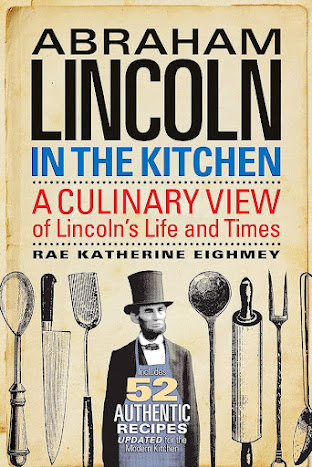
Abraham Lincoln in the Kitchen, A Culinary View of Lincoln’s Life and Times
Rae Katherine Eighmey
The novelization of a key era must read like a story and stories include details about how the protagonists and antagonist lived. A writer can go overboard on food, lodging, transportation, clothing, etc. but a sprinkling of these details enlivens the narrative. Luckily, the description of ordinary people’s lives became an academic trend, and when I wrote Tempest at Dawn, I found countless books on the day to day life of our Revolutionary forebears. For some reason, descriptions of culture and daily routines are harder to find for the Civil War period. Actually, books about common soldiers are abundant, but I’m writing a novel about the politics of the war, not the battles.
Abraham Lincoln in the Kitchen helped fill the void. I’m not a
cook, so I merely scanned the fifty-five recipes, but these are surrounded by
excellent descriptions everyday life, especially food procurement, preparation,
and consumption. Each chapter covers a specific historical period and Eighmey
does a good job of sleuthing out how Lincoln lived and accurate period recipes.
I’m unqualified to review the recipes, but I have read enough period history to say that Eighmey did her homework, which gave me confidence to rely on her descriptions on mundane daily activities.
The subtitle, A Culinary View of Lincoln’s Life and Times, is more accurate than the main title, Abraham Lincoln in the Kitchen. Eighmey does list a couple of references of Abe helping out in the kitchen, but this did not appear to be frequent. Most historians say that Lincoln was disinterested in food and ate lightly. My greatest insight from this book is that this common wisdom is only partially true. Lincoln enjoyed being around people and he also enjoyed being the center of attention. Food is frequently prevalent when people gather, but telling stories without a mouthful hampers chowing down. In the right setting, it appears Lincoln had a healthy appetite, but when distracted by thoughts or an audience, he could neglect to fuel his body. Another insight is that Mary was much more of a homemaker than generally conveyed. Reading about their pre-presidential life made me think their marriage was stronger than I had previously assumed.
 |
| Abraham Lincoln: The Boy The Man by LLoyd Ostendorf |

Abraham Lincoln and The Second American Revolution by James M. McPherson
This book is a collection of seven essays on the Civil War. Originally,
these essays were lecture notes. They are well written and thoughtful. The
common theme is that the Civil War was a second revolution because it resulted
in revolutionary transformations of the country and was accompanied by a
counter-revolution a couple decades after Appomattox. Each essay covers a
single premise and can be read separately.
Slavery divided the nation in 1787 and severed the nation in
1860. Many have said that the Civil War settled the key issue kicked down the
road by the Constitutional Convention. Did the Civil War finish the Founders’
work or was it in and of itself revolutionary? Read Abraham Lincoln and The
Second American Revolution and decide for yourself.
Ending slavery in the United States was horrendously
difficult. It took a four year war with about 620,000 deaths. The politics were
byzantine and the warfare brutal. Reunification was even more ferocious, and absent
Lincoln, the backsliding undid much of the accomplishment.
In the end, I found this to be a sad book.
.jpg)

This post deals with two books on the “Lost Cause.”
Thomas J. DiLorenzo presents the case for the Lost Cause in The Real Lincoln: A New Look at Abraham
Lincoln, His Agenda, and an Unnecessary War, while Edward H. Bonekemper
argues against the Lost Cause in The Myth
of the Lost Cause: Why the South Fought the Civil War and Why the North Won.
What is the Lost Cause? The basic tenants are as follows: the War of Northern Aggression had nothing to do with slavery; the South did nothing to provoke war; the Constitution included a right to secede and the South should have been allowed to leave peacefully; antebellum life in the South was prosperous, dignified, and just; slavery was already dying; Robert E. Lee deserved deification, U. S. Grant deserved demonization, the North deserves condemnation for engaging in total war; the South had no chance of winning, and most important of all, Lincoln was a despot who started the war by invading South.
Basically, the Lost Cause is innocence victimized.
(These are research books for Maelstrom, a sequel to Tempest at Dawn.)

I’m not a Gore
Vidal fan. I thought Burr was a hash, especially from a historical perspective.
Lincoln is a better novel, but still blemished due to Vidal’s penchant
for showing off. A novel is a story, and the
cardinal rule of storytelling is to never jerk the reader out of the story, but Vidal continuously interrupts his characters mid-scene to take a bow. Witty
asides, overly clever dialogue, meaningless gossip, and focus on the trivial when the reader yeans for
the big picture, are bad enough, but the near absence of transitions is
jarring. Vidal goes from one scene to another with a whole different cast of
characters without even a “by your leave.” It is like, “Hey, I veered off over
here, catch up.” And you do, but it takes the rereading several sentences. By
then the magic is gone.
The book
is titled Lincoln, but Ol’ Abe comes across as a side character. He is
explained by countless others that surround the supposed protagonist. Most
of these characters come across as untrustworthy narrators. Characterization is
not a Gore Vidal strong suit. Everyone seems similar and each carries a little
of Vidal’s rapscallion nature. Vidal likes rogues, scoundrels, and outright villains
and ascribes his characters' motivations to the dark side of human frailty.
Some
historians have taken issue with the historical accuracy of Lincoln. As
a historical novelist, I know strict adherence to facts presented in their proper
order does not always lend itself to good storytelling. In this readers
opinion, Vidal’s may skew events and people to his viewpoint but, for the most
part, his violations are inconsequential. This is a well-researched book and
Vidal’s relaying of events, large and miniscule, is generally accurate.
If you
prefer history presented as a story, Lincoln is the best novel about
Lincoln available ... until I publish Maelstrom.

A lot happened between July 9th and the 12th in 1864. Marc Leepson has made this short period of the Civil War the focus
of his book Desperate Engagement: How a Little-Known Civil War Battle
Saved Washington D. C., and Changed American History.
In the end, the battle changes little other than perhaps delaying the end of the war. General Grant continued his stranglehold on the Confederate Army surrounding Richmond until Lee surrendered at Appomattox. Nonetheless, if the Hail Mary pass had been completed and General Jubal Early had sacked Washington, we might be all speaking with a Southern accent.
It was
close. Heart-stopping close.
The risky moves and countermoves, potential payoff, and unbridled
heroism on both sides should have made this an exciting book. The Battle of
Monocacy and attempted siege are nicely covered in about four or five chapters
with the remaining chapters filled mostly with letters and memoirs of the
participants, asides, or research factoids. Civil War buffs should find even
the trivia interesting, but a casual reader might view much of this text as fill.

Lord Charnwood published Abraham Lincoln in 1916. In
order to get a clearer perspective of the Civil War, it helps to read books
from multiple viewpoints. Lord Charnwood wrote only fifty years after the war, bringing
an almost contemporaneous perspective to his depictions. His biography has the
advantage of proximity but with enough time elapsed to dampen the passions of
the moment. More important, as an English depiction, it is a simultaneously a distant
point of view. It is a distance of more than nautical miles. Lord Charnwood
also brings the bias of English nobility to his descriptions. This is
exceptionally important in gaining an understanding of the diplomatic
imperative for both sides. The Confederacy desperately sought European
recognition of their legitimacy, while Lincoln did everything in his power to
deny international recognition and suppress arms and funding from abroad. Lincoln’s
success was arguably pivotal to eventually making victory possible.
Abraham Lincoln,
by Lord Charnwood can be a tough read. A simple, declarative sentence is beyond
the baron. This is partly due to the style of the times and partly the way of
academics who feel a need to qualify every utterance. Once the reader adjusts
to the wordily writing, nuggets of rare perspective make the effort well
worthwhile. For example, Thomas Jefferson is not one of my favorite Founders
and Lord Charnwood seems to have shared some of my reservations. He also makes
other political observations that an American might be reluctant to express.
If you have an interest in the mid-nineteenth century, Abraham
Lincoln by Lord Charnwood can be an enlightening read.

This booklet was published in 1921 by a veteran of the Civil War. The author’s intent is to advocate for The Cause and expose the “truth.” I’ve read several modern-day defenses of The Cause, but I wanted to get the perspective of someone closer in time to the conflict. A participant was even better, although Johnstone served for only an unexplained eight months. Unfortunately, time and participation provided few novel insights. I shouldn't have been surprised because years earlier Jefferson Davis had articulated the dogma of The Cause in his two histories of the Confederated States of America.
Johnstone presents the case that a duplicitous President Lincoln started the
war by reinforcing Forts Sumter and Pickens, the last Union military presence in
the seceded states. First, the duplicitous part. In his inaugural, Lincoln
said, “The power confided to me will be used to hold, occupy, and possess the
property and places belonging to the Government.” All other military
installations had been confiscated prior to his inaugural, so he could only have been speaking about Sumter and Pickens.
What act
started the war? Secession of seven states in response to the election of a Republican or
Lincoln taking office despite threats of assassination? The confiscation of Federal
property under threat of physical attack or denial of weapons, munitions, and
battlements to a belligerent? Does relentless bombardment of Sumter constitute
an act of war or providing food and water to those starving soldiers? The South had been threatening war ever since a split Democratic Party guaranteed the election of a Republican. They made good on their threats.
Despite the
reality of the situation, Johnstone paints Lincoln as despotic for not surrendering to the demands of the seceded states. Prior to inauguration,
did he distance himself from Seward and the Peace Conference? He did. In his
mind, he did not yet have authority to intervene. Did he dispatch war ships
to accompanying the resupply ships? He did, but he sent the South Carolina governor
a message that he would peaceably resupply the fort unless met with resistance. To deal with resistance if encountered, he needed naval war ships. Did
Lincoln maneuver to put Jefferson Davis in a box? He did. And he did this successfully because he
was a better politician.
Johnstone was right about one thing. The war could have been avoided if Lincoln had acceded to every demand. Forever.
Since the Constitutional Convention, slave states had been demanding that the North acquiescence to their peculiar institution or they would bolt. Bolt they did. Not over slavery in their own states, but because the Republican platform vowed to use federal powers to stop any further expansion of slavery.
Perhaps the war was inevitable. Once the South was independent, new demands of their neighbor would never cease. Sooner or later, there would be one demand too many.
 |
| The Land of Lincoln |
This is a fun memoir of a modern-day search for the real Abraham Lincoln. In childhood, Andrew Ferguson had been a Lincoln buff but had developed other interests in adulthood. The enigmatic and “shut-mouth” Lincoln provided pundits an open field for speculation. As a result, a plethora of interpretations have been tossed around that purport to explain his personality, beliefs, motivations, administration, family, and even sexual orientation. Glorifying tributes stand beside hate filled censures. Ferguson trekked across the country to get a fix on the man. He traversed the Lincoln Heritage Trail with his family, visited major and not-so-major memorials, interviewed Lincoln collectors, gawked at Lincoln impersonators, and talked to guides, academics, and park rangers. Lincoln remained elusive, but Ferguson’s wit and lively writing style kept the quest entertaining and educational … although the reader may learn more about modern-day Americans than they learn about our sixteenth president.
I enjoyed the journey. Thanks, Andrew, for taking me along
on the ride.
(This is a research book for Maelstrom, a sequel to Tempest at Dawn.)
