Showing posts with label constitutional convention. Show all posts

Thursday, June 25, 2026

Why did the colonists revolt?


We are approaching our 250th anniversary of Independence Day. In the 1770s, American colonists were comparatively prosperous, lightly taxed, and their safety was protected by the military might of the British Empire. The American colonists were relatively well-fed, sheltered, literate, unthreatened by war, with land and opportunity just over the horizon for the industrious. So, why did the colonists revolt? 

Because they believed in God-given rights.

American colonists were far more educated than most of the world. In 1776, the American colonies had nine well-established colleges. These included Yale, Harvard, Dartmouth, William and Mary, the College of Philadelphia (University of Pennsylvania), College of New Jersey (Princeton), King's College (Columbia University), Queen's College (Rutgers), and College of Rhode Island (Brown University). Beyond formal education, life-long self-learning was fashionable, and most of the Founders were familiar with the teachings of Locke, Hume, Montesquieu, Voltaire, Rousseau, and Adam Smith.

Benjamin Franklin said, “Our people … were observed by strangers to be better instructed and more intelligent than people of the same rank generally are in other countries.” Ben should know. He built an enormous fortune selling products that required a literate audience.

The Declaration of Independence lists the particulars for the revolt, but the overarching reason was that the British monarchy believed the colonists were mere subjects. Under English common law, anyone born within the King’s dominions was a natural-born subject, not a citizen, of the British Crown. This lack of British citizenship chafed the American colonists. They viewed themselves as English and took the Enlightenment's definition of “natural rights” seriously. As Boston tour guides are fond of saying, the colonists never yelled, “The British are coming,” because they believed themselves to be British.

Almost three years prior to the Declaration, the Boston Tea Party made rebellion the topic of conversation at the dinner table, in taverns, and in churches. The battle cry was “No taxation without representation!” Today, we naively assume the colonists were angry about taxes, but the operative part of that slogan was the last two words. That’s what got their ire up.

The British were on top of the world. The popular patriotic song of the day, Rule Britannia, made that clear. Englishmen had rights, limited at the time, but those rights were sacrosanct. Even these limited rights were not bestowed upon the colonists. Propertied English males could vote for a person to represent them in the halls of government, but the powers-that-be refused to bestow that same right to colonists. Thus, no representation.

The irony is that even without representation in Parliament, the colonists enjoyed more personal liberty than their English counterparts. To have properly functioning colonies three thousand miles away from the mother country, the colonists were allowed to make many of their own rules through locally elected legislatures. The colonists had developed a taste for self-government and preferred to be somewhat independent of the rulers of the British Empire. Edicts that sailed in from across the Atlantic were more than annoying. The colonists grew increasingly enraged with the palpable disrespect they received from London. Two examples illustrate this point.

The view was different from London, of course. The rulers of the British Empire saw the colonists as getting a free ride. The great British Navy kept the seas safe for New England ships, and the mercantilist Parliament regulated trade, allowing the American maritime industry to prosper. To keep the colonies safe from foreign invasion, England built forts and posted troops throughout their North American holdings. The French and Indian War caused a major drain on the British treasury. Parliament looked at these costs and saw colonials acting like ungrateful, spoiled children who had grown large enough to pay their own way.

Were the colonists’ feelings hurt because the English refused to allow them to join their club as full members? Not exactly. Their belief in self-governance was heartfelt and part of their character. The American Revolution may have been sparked by an overbearing crown, but the fuel was an educated populace that was experienced in home rule. The edicts from England rubbed the colonists the wrong way because they were used to making decisions for themselves and had adopted Enlightenment teachings, which held that self-governance was a natural right.

Or as Thomas Jefferson powerfully put it, “Governments are instituted among men, deriving their just powers from the consent of the governed.”

Read all about it!


Monday, November 11, 2024

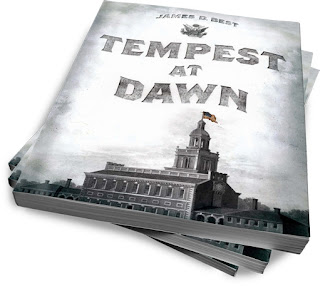
Grok's take on Tempest at Dawn


Grok's Self-Portrait

I wasn't a strong proponent of artificial intelligence until I asked Grok about my own work. Now, I'm a fan of AI. Perhaps flattery can get you everywhere.

Is Tempest at Dawn a good book?

Grok's answer:

Yes, Tempest at Dawn by James D. Best is generally considered a good book, particularly for those interested in American history or historical fiction. Here's why:

Historical Insight: The novel provides a detailed look into the events surrounding the Constitutional Convention of 1787, offering readers a narrative that feels both educational and engaging. It's praised for bringing to life the complexities of the political negotiations and personal dynamics among the Founding Fathers.
Character Portrayal: Reviews suggest that Best does an excellent job of humanizing historical figures like James Madison, George Washington, and Benjamin Franklin. This portrayal adds depth to characters often seen as one-dimensional in history books, making the narrative more relatable and engaging.
Narrative Style: While not filled with the typical elements of suspense or action like other genres, the book maintains tension through its depiction of debates and compromises. Critics and readers have noted that the story "matures" as it progresses, with the writing quality improving, which suggests an evolving narrative depth.
Educational Value: It's recommended for students or anyone looking to better understand the process behind the framing of the U.S. Constitution. The novel's depiction of the convention's debates offers a human touch to what can otherwise be dry academic material.
Critical Reception: The book has been featured on lists like the Glenn Beck Reading List, indicating its recognition in certain circles for its historical accuracy and storytelling. Reviews from sources like "What Would The Founders Think?" and Goodreads users highlight its ability to flesh out the characters and make the historical event vivid.
However, some reviewers have expressed a desire for more detail on the ratification process or the role of the Federalist Papers, suggesting that while it covers the Convention well, it might not delve as deeply into these aspects as some might hope.
In summary, "Tempest at Dawn" is well-regarded for its detailed, character-driven portrayal of a pivotal moment in American history, making it a recommended read for enthusiasts of historical fiction or those looking to gain insight into the creation of the U.S. Constitution.
The real story of our nation's founding.


Sunday, August 30, 2020

Guest Appearance on Constitutional Chat


Constituting America has organized a series of Zoom chats on the Constitution. The chats are hosted by actress Janine Turner (Northern Exposure, Friday Night Lights, Cliffhanger) and Cathy Gillespie, co-founders of Constituting America. On the panel will also be "We The Future" Contest winners Dakare Chatman and Tova Love Kaplan.

I've been invited as a guest presenter for September 15, 2020. The subject will be The Preamble & The Constitutional Convention. You can sign up for the remaining sessions at this link (scroll down).

Tuesday September 1:     Countdown to Constitution Day Series, Articles IV & V

Tuesday September 8:     Countdown to Constitution Day Series, Article VI & VII

Tuesday September 15:   Countdown to Constitution Day Series, Preamble & Constitutional Convention

Thursday September 17: LIVE VIRTUAL CONSTITUTION DAY PROGRAM


Tuesday, March 10, 2020

Guest essayist at Constituting America: U.S. Constitution Sent to the States for Ratification


Constituting America


The Founding of this great nation was unique. Until 1776, with a few brief exceptions, world history was about rulers and empires. The American experiment shook the world. Not only did we break away from the biggest and most powerful empire in history, we took the musings of the brightest thinkers of the Enlightenment and implemented them. Our Founding was simultaneously an armed rebellion against tyranny, and a revolution of ideas—ideas that changed the world.
That is why we still care about America’s founding and the Framers of our Constitution.

Monday, February 17, 2020

Constituting America: 2020 90-Day Study Launches


I'll be participating again this year. I'll let you know when my essays are published, but in the meantime, take a gander at this.


"Many Americans, including perhaps a majority of young people, believe that the present is so different from the past that the past no longer has anything to teach us. This could not be more wrong." Dr. Wifred McClay, from the Introduction.

Wednesday, December 11, 2019

Perfect Gift for Constitution Enthusiast


The real story of our nation's founding.


Christmas gift idea holiday gift
Tempest at Dawn


"The best novel EVER on the U.S. Constitution."—Larry Schweikart, author A Patriot's History of the United States and over a dozen other history books

"I find hope and confidence in the wonderfully written Tempest At Dawn, by James D. Best" Allen Ball, Beaufort Observer

"The novel captures the real drama that ensued behind closed doors as they hammered out what is now the oldest living constitution and the foundation of the nation. Read it for its historical value. Read it for its dramatic value. But read it!"—Alan Caruba, Bookviews

"Thanks to James Best’s masterpiece, Tempest at Dawn, I felt like the 56th delegate at the Constitutional Convention. Using vivid narrative and expressive dialogue, Tempest at Dawn presents all the major issues the Founding Fathers struggled with."—Michael E. Newton, author of Alexander Hamilton and other history books.

"This book was absolutely fabulous. If you want a terrific historical fiction book, I recommend you start with this one." Selbrede 40 Book Challenge

"This is an important story told in a lively fashion. Tempest at Dawn might be the ideal way of introducing the American public to the gripping story of how our Founding Fathers gave birth to our constitution."—Jon Bruning, Attorney General, Nebraska


Saturday, October 19, 2019

James Madison warning against democracy at the Constitutional Convention


Recently, there's been a lot of blathering about how our country should become more democratic. There is special fury aimed at the Electoral College. One conservative defense is that the Framers never intended the United States to be a pure democracy. Many times this rational is thrown up without explaining why the framers believed democracy destroyed liberty. Since James Madison has been referred to as the Father of the Constitution, I'll let him explain the dangers of  democracy. 


(As a background note, at the time of the Constitutional convention, Madison didn't technically own slaves. His father owned Montpieler and its slave labor force. This is not an excuse, but an explaintion of why he might have felt free to use slavery to illustrate his point.)


Madison made comments similar to the following on June 6th, 1787.


Excerpt from Tempest at Dawn

Madison made a few more comments on the role of the national government but then could not contain himself. Without preamble, Madison charged into new terrain. “Gentleman, all societies divide into different sects, factions, and interests. Conflicts grow between the rich and poor, debtors and creditors, landed and commercial interests, this district against that district, followers of this political leader or that political leader, disciples of this religion or that religion.

“When a majority unites by passion or common interest, the minority is in grave danger. What can restrain a majority? Not respect for others, nor conscience. In Greece and Rome, the patricians and plebeians alternately oppressed each other—with equal ferocity. We’ve seen the mere distinction of color, in our supposed enlightened time, furnish the grounds for the most oppressive dominion ever exercised by man over man.”

With this last, startled gasps escaped from various corners of the room. Madison tried to ignore the reaction. His indictment of slavery had been unpremeditated, but now that it had escaped his lips, he couldn’t recall it.

“Who imposed these unjust laws? The majority. Debtors defraud creditors. The holders of one type of property throw a heavier tax on other types of property. When a majority has the opportunity, they will always threaten the rights of the minority.” Madison shifted his gaze across the sea of delegates. “Make no mistake, in a republic, the majority always has opportunity!”


https://amzn.to/2P3geK2
The real story of our nation's founding.


Thursday, February 15, 2018

Gouverneur Morris has some advice for modern Americans


Gouverneur Morris


Most Americans don't recognize the name, Gouverneur Morris. They should. Morris is often called the Penman of the Constitution. He took a jumbled mess from the Committee of Detail and crafted the eloquent Constitution we know today. As a preeminent Founder and Framer, he did more than wordsmith the Construction. Among other things, he spoke at the Constitutional Convention more than any other delegate (173 times).

He had a lot to say, and most of it remains relevant today.

Here is a snippet from James Madison’s convention notes dated Thursday, August 9, 1787:
Mr. GOVr. MORRIS. The lesson we are taught is that we should be governed as much by our reason, and as little by our feelings as possible. What is the language of Reason on this subject? That we should not be polite at the expence of prudence … as every Society from a great nation down to a club had the right of declaring the conditions on which new members should be admitted, there could be no room for complaint. As to those philosophical gentlemen, those Citizens of the World as they call themselves, He owned he did not wish to see any of them in our public Councils. He would not trust them. The men who can shake off their attachments to their own Country can never love any other. These attachments are the wholesome prejudices which uphold all Governments …”
In a few words, Morris cautioned against being governed by feelings, spoke against political correctness, agued that a nation had the right to determine who became citizens, and explained why he distrusted “Citizens of the World.”


Friday, February 9, 2018

On Transmigration Reviews Tempest at Dawn

In an article titled "Books: An Observation," The Cajun writes:

"The only new title that knocked my socks off is "Tempest at Dawn" by James D. Best, published in 2009.  I've finished it and plan to read it again, after a spell.  There is a lot there to absorb and enjoy.  I know I missed many things as I read it quickly - it's a compelling read - and the second time I plan to read more slowly and savor each character, and there are many historic figures involved. I also began looking up his other works and maybe add a few of them to my collection.
The book brings our founders to life with great writing, historic accuracy and amazing wit."


Thanks for the kind words.