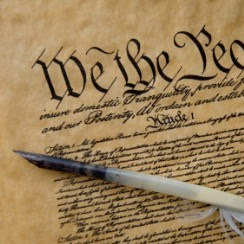
Sunday, April 18, 2021

Vilify our Founders? To what purpose?


Most of us watched aghast as hoodlums ripped down Confederate flags and statues. Democrats seamlessly progressed beyond heroes on horseback to our revolutionary Founders and Constitutional Framers. After a couple years, the absence of a statue will hardly be noticed, so these acts had little consequence. Wanton destruction may have seemed mindless, but there’s a bigger goal in mind.  Their end game is the obliteration of our Constitution.

Democrats have always hated the Constitution. Our system of government hinders ruling in a manner they deem appropriate. They’ve whittled at the edges for over two hundred years, but the Framers were so clever that even a stripped-down version remains a forceful restraint against them exercising their full ambitions. To a committed progressive, the Constitution must be brushed aside so real progress can be made.

Here’s their problem.  The Constitution has become so entrenched in our American culture that it’s more than words on parchment. The Constitution is as American as baseball and apple pie. To rid the nation of something that ingrained, the first task is to discredit the authors.

The Founders feared centralized power so they designed an instrument to thwart the ambitions of despots and crackpots. For perspective, let’s look at the intent of the Framers and some of the erosion of their vision.
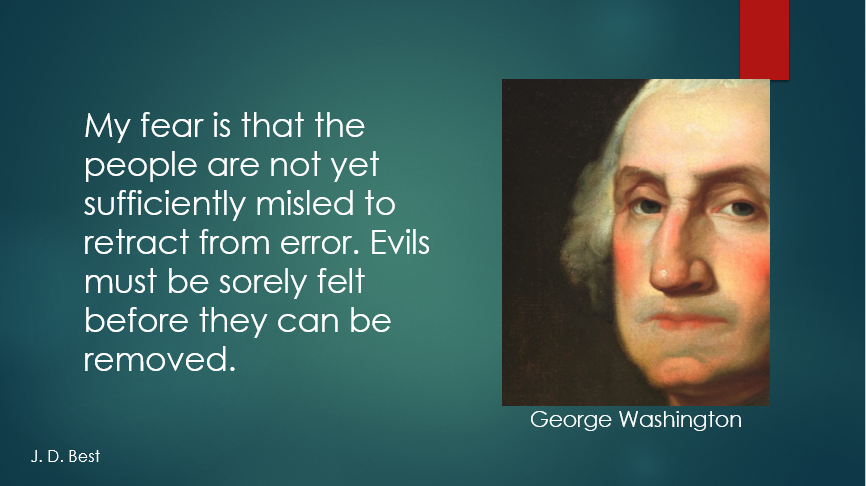

Most Americans are familiar with the term checks and balances.  It is often spoken as if it were a single word, but in the eighteenth century, the phrase represented distinctly different concepts.  John Adams may have been the first to put the words together in his 1787 publication, A Defense of the Constitutions of Government of the United States, but balances and checks is the phrase used in The Federalist, and that is the sequence James Madison would have thought appropriate.  First balance powers between the branches of government, then place checks on those powers so they may not be abused.

The Framers first line of defense was enumerated powers, later reaffirmed by the states and Congress with the 10th amendment.  Unfortunately, few in Washington consider the enumerated powers a present-day constraint.  Many find it amusing that someone might claim there are limits on national power.

Another bulwark erected by the Framers against concentrated power was a limited national taxing authority. Squeeze the purse, throttle the power. However, progressives under Woodrow Wilson passed the 16th Amendment, which allows the government to “collect taxes on incomes, from whatever source derived.” That pretty much took care of any money restraint.

The delegates to the Constitutional Convention intended the states to provide a potent check on the national government.  They included five provisions for this purpose: enumerated national powers, equal state representation in the Senate, senators elected by state legislatures, limited national taxing authority, and the Electoral College.  The 17th Amendment, also passed under Wilson, provided for the popular election of senators, so three of the five provisions have been negated while the other two are under assault.

Despite these and other erosions the Constitution remains a potent restraining order against overly ambitious politicians. Healthy tension exists between the three branches and most of their respective powers remain intact. Something must be done. The rebellion has already progressed from flags and statues to condemnation of the Founders and Framers. In recent years, learned articles have periodically appeared that impugn our Constitution as too restrictive, woefully out of date, and written by white males who owned slaves. (The first is a feature, not a flaw; the second untrue; and the third partially true but irrelevant.) In the coming months, expect to see many more think-pieces along these lines.  On cue, criticism will expand to the popular culture. The topic will crest when late-night talk show hosts tell disparaging jokes about the Framers and our Constitution.

We cannot allow this to happen.  Fifty-five highly educated and talented men debated daily for four months to define a government that would work for the people while shielding them from the power crazed. Their work was ratified by the people who argued at home, at church, in taverns, and in print until every facet had been examined and reexamined. New states, wars, depressions, state succession, GDP growth, longevity, twenty-seven amendments, and the constant striving to live up to our founding principles proves that the Framers’ foresight remains invaluable.

Human frailties are no reason to throw away the Framers’ brilliance. 

Rapacious politicians are reason enough to heed their counsel. 

Tuesday, April 13, 2021

Socialism is for Losers


Why has socialism become trendy? Why would a presidential candidate laud a government system that carries a heartbreaking record of failure? Millions have died under socialism and its more virulent permutations. Hundreds of millions have suffer deprivation and bondage under this egregious form of authoritarianism. Venezuela is crumbing with people fleeing in every direction. Misery and despotism entrap North Koreans while their brethren to the south live in the eleventh richest nation on Earth. There are no boats of refugees risking life and limb to get to Cuba. Despite a mass inflow of Muslim immigrants into Sweden, the supposed Shangri la of socialism has a net emigration rate of 5.3 per thousand. Not a ringing endorsement for the Left’s utopia.

(Technically, Sweden is not socialist. They’re a welfare state adept at allowing enough free enterprise to bankroll government services. Sweden recognizes that only capitalism builds wealth. Despite slow growth and skattetrat, this model has previously worked relatively well because of a small population and homogeneous culture. This will be tested in coming years with the influx of cultures eager to seize the benefits of Swedish welfare.)

People who have lived under socialism certainly don’t like it. Eastern Europeans aren’t buying this crap. Cubans who escaped are ardent conservatives and Castro haters. Even people in Russia and Albania prefer a kleptocracy to communism. You don’t see India or China backing away from their shift to a market economy.  The truth is capitalism has lifted scores of millions out of poverty. 

So, again, who in the world likes socialism? To answer this question, we need to examine capitalism. Capitalism is competitive ... and competition is the engine that drives enormous growth in wealth and wellbeing. Businesses and entrepreneurs strive to invent or concoct stuff people will buy. To thrive, they need the public to willingly trade hard-earned money for their products and services. It's rough and messy and stressful. You could be on top this year and find yourself run over by some whippersnapper next year. If you’re an individual contributor, you need a marketable skill or talent. If you want more of the American Dream, you need to continuously hone your skill or talent. This constant tension to invent, innovate, and work drives wealth creation under capitalism. Sometimes the rug gets pulled out from under you, and although you may get a tad of help from safety nets, the ultimate onus is on you to pick yourself up. 

Capitalism is not a laid-back system. Some thrive under it, others not so much.

Capitalism also provides checks and balances as it disperses power between government, business, religions, and non-profits. When capitalism is mentioned, most people think of big corporations, but family businesses account for 64 percent of gross domestic product and 62 percent of employment. Family businesses grow faster, hire faster. New entries that knock Fortune 500 companies off the listing come from up-and-comers that previously resided below the last ranked firm. 

Turmoil and change is endemic to capitalism.

Under socialism, government owns most or all the means of production. (Under fascism, government and large corporations collude to the same result.) Socialism concentrates power and money in the government. Checks no longer exist because no balance exists. Power-crazed politicians hunger for socialism because it makes them and their friends all powerful. Government, enterprise, and doctrinal adherence are consolidated into a single entity. This is the way Europe was ruled during the Dark Ages. Nobility and the Vatican colluded to hold all power in the hands of a few aristocrats. The outcome was slow growth, lackluster societal advancement, and little social mobility. Everyone had a place ... and everyone knew their place. Enforcement of the system led to repression and extreme concentration of wealth.

So, who in the world likes socialism? 

Losers.

Calling someone a loser might sound like a pejorative, but the fact remains that there are losers under capitalism. Some can’t make it in the rough and tumble world of capitalism. Some of those take a government job or run for office. Despite turning their back on free enterprise, many still lust after the rewards of capitalism. They’re jealous of people in the private sector and resent their ability to accumulate wealth. They see it as a wrong. They want—no, need—to get their hands on the largess of a free market system. Socialism provides the answer for these losers. As government employees or officials they reap the rewards of others' industry. The total economy will be smaller, but their share is humongous compared to public servants under capitalism. Never mind the misery of the masses, they have the best food, nice clothes, and all the creature comforts imaginable.

There's a problem: how do they sell socialism to the general populous? They appeal to people without job skills, people without education or training, people with impairments, people with addictions, people with a criminal past, people with debts, people who made poor life choices, people with mental illnesses, people here illegally, and the marginalized who can’t get a fair shake. Are there enough of these people to overthrow the greatest wealth creation engine ever invented? Elections have proved no. So the power-crazed cheat in elections, manufacture more losers, and import the poor from other counties.

Capitalism broke us out of feudalism and brought a decent livelihood to the masses. Socialists want to create a new nobility and make everyone else serfs again. Being a slave to the state is no different than being a slave to a master. Your betters decide how you live, what work you do, and how much you are paid. To keep everyone in their place and maintain discipline, government bureaucrats control what you say and even what you may think. If you don’t believe me, seek out someone who has lived under socialism.

Politicians ought to forthrightly debate the human and financial cost of forcing equality among commoners. Unfortunately, socialism consumes wealth and eventually makes everyone equally impoverished. But that is not the primary reason to avoid socialism.

The real crime of socialism is that it sucks the heart out of a nation and its people.


Sunday, April 11, 2021

Government and Economics Made Dead Simple


Keep it simple

There are only two types of governments. Two. That’s it. Those where the people control the government and those where the government controls the people. Likewise, there are only two types of economic systems. Economies where free markets control commerce and economies where bureaucrats control commerce.

It’s that simple.  Really.

The Two Types of Governments

Most governments control people. This has been the case throughout history. Proponents of Big Government used different nomenclatures to describe their ideal system, but they all have one overriding characteristic—power centralized in government.

Socialism, fascism, communism, feudalism, monarchies, dictatorships, theocracies, police states, a unitary state, oligarchies, et. al. concentrate power in the state. The underlying political theology is irrelevant. In each and every case, the individual is subject to control by the state. It doesn’t matter who orders you about. It could be a king, emperor, dictator, a party general secretary, or an elected machine politician. The result is the same. You do as you’re told. You’re a serf, plain and simple.

Occasionally, people control government. This is rare. Those fortunate nations believe that people are born with natural rights and inherently possess the liberty to direct their own lives. The term democracy is bandied about, but nations based on sovereign individuals are never pure democracies. Democracies can take whatever they want from groups outside the majority voting bloc. Instead of being sovereign individuals, those outside the mainstream can be victims of the popular vote. As James Madison pointed out, slavery would be a perfect example of this concept.

Countries that respect an individual right to “life, liberty, and the pursuit of happiness” are representative republics or parliamentary systems with safeguards for minority interests.

The United States of America was founded on the principle of sovereign individuals—an idea that flipped the concept of “divine right of kings” on its head. Instead of rulers being ordained by God to rule, each and every person was “endowed by their Creator with certain unalienable Rights.”  
Of course, nothing’s absolute in this world, but the greater the power of the state, the less power held by the people. Our Founders understood this and possessed a healthy fear of an overly powerful government.

Two Types of Economies

Commerce enables our lives. Few can self-provide all of life’s necessities, so the human species has always relied on trade to get some of what they need or want. 

In centrally managed systems, bureaucrats decide what gets produced, in what quantity, and how these goods are distributed. If you believed in the infallibility of man, you might think this is a nifty system. You’d be wrong. It’s been tried countless times and always failed to deliver the goods. State run economies generate shortages that never seem to go away. You see a line; you get in line. It doesn’t matter what they’re selling. You either need it or can trade it on the black market for what you do need. Oh yeah, state run economies always have black markets. The ruling class disparages black markets because the term really denotes the sector of the economy that remains market driven. To see something work without government direction is embarrassing to bureaucrats.

Centrally managed economies generate shortages. On the other hand, market driven economies produce abundance. Why? Because every time you buy something, you’re voting for what you want. Independent producers, with no guidance from above, tally these votes and make more of what you bought. They do this to make a profit.

Profit is the fee producers get for making desirable stuff available to the public.  If you don’t like it, they lose. If you like it a lot, they get rich.  If that’s not clear, ask Steve Jobs, Taylor Swift, or LeBron James. The dollar incentive to get the right stuff to market is what makes a market economy hum. At times profits get exorbitant, but other producers see this and rush to get in on the action. Unless … the current producers are in cahoots with the government. You see, governments can create barriers that other producers can’t overcome, thus ensuring that their chosen suppliers continue to make a killing. The chosen suppliers, of course, provide kickbacks to their political overlords. This is called crony capitalism, or in its extreme variant, fascism.

Which brings up a final point. Nothing in this world is black and white. It’s a gray scale. Different governments wield different levels of power. But once the centralization of power passes the tipping point, governments go totalitarian. All of them. No exceptions. Human beings are flawed creatures. Some have an inborn need to control everyone else. Control obsessed individuals are never satisfied and constantly strive to increase their control over every aspect of society.  They claim that they’ll take care of you, but it’s a bait and switch game. They really want you under their thumb.

Socialism does more than deny you material things, it sucks the soul out of a society. Socialist countries are sad, dreary places.

Final Take-Away

Excessive power in government is bad. Period! Socialism concentrates governmental and commercial power in the state. No checks, no balances. Raw power centralized in one place where the most ruthless can grab it to dominate other human beings. For most of the eight billion people on Earth, this is their way of life. Why would we want to join them?

Our freedom depends on We The People controlling our government … not the other way around. Freedom is a precious commodity.  So rare, few in history have experienced it.  As Ben Franklin put it so succinctly, the real question is can we keep it.

Monday, March 1, 2021

Constituting America's 90-Day Study – Our Lives, Our Fortunes & Our Sacred Honor – Exploring the Declaration of Independence


Guest Essayist: James D. Best, Author, Tempest at Dawn, a novel about the 1787 Constitutional Convention; and Principled Action, Lessons from the Origins of the American Republic


Right of the People To Alter or Abolish Government

“That whenever any Form of Government becomes destructive of these ends, it is the Right of the People to alter or to abolish it,”

Read the essay here ...


Wednesday, December 2, 2020


Jennifer N. Fenwick has written an excellent blogpost titled Government of the People, by the People, for the people – What That Truly Means. In the process of deftly describing our heritage, she gives a nice shout-out to Tempest at Dawn

Many of the compromises, though hard for us, some two-hundred years on, to understand, were born from necessity. For a compelling inside look at that Summer in 1787, I encourage you to read Tempest at Dawn, by James D. Best. Based on the diaries of Madison and other delegates, along with correspondence and other written records of the day, Best’s book is like having a front-row seat to the Convention and the writing of our Constitution.

Fenwick is the author of several books including, In the Eye of the Storm: Stories of Survival and Hope from the Florida Panhandle.


Wednesday, November 18, 2020


Michael E. Newton Hamilton Books


The Schuyler Mansion State Historic Site in Albany, New York recently published a piece by Jesse Serfilippi titled “As Odious and Immoral A Thing: Alexander Hamilton’s Hidden History as an Enslaver.”

Was Alexander Hamilton an enslaver?

Two Hamilton historians, Philo Hamilton and Michael E. Newton, dispute the accusation.

A recent essay by Jessie Serfilippi published by the Schuyler claims to reveal, according to the work’s subtitle, “Alexander Hamilton’s Hidden History as an Enslaver.” The errors, omissions, assumptions, speculations, and misrepresentations in that essay called for a more complete and accurate evaluation of Hamilton’s history with slavery.

There is no evidence that Hamilton owned slaves or was an ‘enslaver.’ While there is evidence that he helped his in-laws with slave transactions, it appears that Hamilton in these transactions was acting merely as a banker. Regarding Hamilton himself, there are at least five pieces of evidence—two census records, a contemporary statement by Angelica Schuyler Church, a comment by John C. Hamilton in his biography of his father, and the lists of assets Hamilton drew up just prior to his death indicating that Alexander Hamilton did not own any slaves … Alexander Hamilton was on the right side of the slavery issue. In addition to not owning slaves, he actively sought to abolish the evil institution in his own state. Rather than being an “enslaver,” Hamilton opposed slavery, advocated for manumission and supported enslaved and freed blacks to the extent that his limited means allowed.


Tuesday, October 6, 2020

Breaking Down The Constitution: Preamble & Constitutional Convention (Jim Best)|Constitutional Chats

What exactly happened when delegates from all 13 states met to write the Constitution? In Part 7, the final installment of the “Breaking Down the Constitution” series, Janine Turner, Cathy Gillespie, and Student Ambassadors Tova Love Kaplan and Dakare Chatman interview author James D. Best on the proceedings of the Constitutional Convention, how the Preamble serves as the “elevator pitch” for the Constitution, and more!


Monday, September 14, 2020

The Preamble to the Constitution of the Unites States of America


Thursday, September 17 is Constitution Day. 

Constituting America has run a series of Constitutional Chats leading up to this signing anniversary of the longest lasting constitution in world history. On Tuesday, September 15, I will be a guest on the final chat leading up to a full-day celebration on Constitution Day. You can register for both events here.

The subject of Tuesday’s chat will be the preamble and the Constitutional Convention.


We the People of the United States, in Order to form a more perfect Union, establish Justice, insure domestic Tranquility, provide for the common defence, promote the general Welfare, and secure the Blessings of Liberty to ourselves and our Posterity, do ordain and establish this Constitution for the United States of America.

The preamble to the Constitution is a declarative statement that grants no powers to the national government. Basically, it states the overarching goals of this new Constitution, meant to replace the Articles of Confederation. The declarative nature of the preamble was confirmed by the Supreme Court in Jacobson v. Massachusetts (1905).

The United States does not derive any of its substantive powers from the Preamble of the Constitution. It cannot exert any power to secure the declared objects of the Constitution unless, apart from the Preamble, such power be found in, or can properly be implied from, some express delegation in the instrument.

The preamble was basically the elevator pitch for an entirely new government system.


We the people of the United States

The draft document listed all thirteen states, but Gouverneur Morris changed it to the famous seven words. Morris probably made the change for three reasons. First, no one knew which states would eventually ratify and it took only nine; second, Morris wanted to emphasize a single nation; and third, listing the states was ineloquent. The conventional interpretation is that he changed the enacting entity from the states to collective people. There is no doubt the convention meant to take ratification away from the states as represented by their legislatures. Ratification was to be by state conventions of “the people.” Madison had preached ad nauseum that only the people had the authority to bestow power to a governing agency.

a more perfect Union

No one would argue that the nation under the Articles of Confederation was anywhere near perfect, but many of its authors were delegates to the convention and denigrating their work was not an effective way to garner support.

establish Justice

The consensus was that states were violating individual rights. The country was on the brink of total collapse. The military has been reduced to near extinction, economic turmoil saps hope, and anarchy threatened. Establishing justice had strong appeal.

insure domestic Tranquility

The elephant in the State House chamber was Shay’s Rebellion and other uprising throughout the states. The Articles of Confederation did not bestow sufficient authority to quell these rebellions.

provide for the common defence

With the nation in chaos, foreign powers hovered like vultures, ready to annex the states to their empires.

promote the general Welfare

At the time of the convention, general welfare was generally assumed to mean well being or happiness. This phrase thus echoes the Declaration of Independence. Since the preamble does not bestow powers, this clause does not give the national government unlimited power to do “good.”

secure the Blessings of Liberty to ourselves and our Posterity

The Federal Convention proposed this Constitution for their own benefit and for the benefit of “millions yet unborn.”

The Federal Convention

The Federal Convention debated for four months, but the final form of the Constitution was primarily crafted by three committees: The Committee of Detail, the Committee of Postponed Matters, and the Committee of Style. The work of these committees was approved by votes of the full convention. Gouverneur Morris, called the Penman of the Constitution, was a member of the five-person Committee of Style. Morris took home the draft from the prior committees and crafted an eloquent document that was approved by the other four members: William Johnson, James Madison, Alexander Hamilton, and Rufus King, and then by the full assembly, and finally ratified by conventions of the people in each state.

I use this paragraph before, but I believe a reminder is worthwhile on Constitution Day.

We often hear laments that elected officials no longer honor their pledge to preserve, protect and defend the Constitution of the United States. This is backward. The Constitution wasn’t written for politicians. Our political leaders have no motivation to abide by a two hundred and thirty year old restraining order. The first words of the Constitution read We the People. It’s our document. It was always meant to be ours, not theirs. It’s our obligation to preserve, protect, and defend the Constitution of the United States.


Sunday, August 30, 2020

Guest Appearance on Constitutional Chat


Constituting America has organized a series of Zoom chats on the Constitution. The chats are hosted by actress Janine Turner (Northern Exposure, Friday Night Lights, Cliffhanger) and Cathy Gillespie, co-founders of Constituting America. On the panel will also be "We The Future" Contest winners Dakare Chatman and Tova Love Kaplan.

I've been invited as a guest presenter for September 15, 2020. The subject will be The Preamble & The Constitutional Convention. You can sign up for the remaining sessions at this link (scroll down).

Tuesday September 1:     Countdown to Constitution Day Series, Articles IV & V

Tuesday September 8:     Countdown to Constitution Day Series, Article VI & VII

Tuesday September 15:   Countdown to Constitution Day Series, Preamble & Constitutional Convention

Thursday September 17: LIVE VIRTUAL CONSTITUTION DAY PROGRAM


Friday, July 24, 2020

Human frailties are no reason to discard the Framers


George Washington was the president of the Constitutional Convention, then called the Federal Convention. He led the contentious gathering brilliantly and gently guided it toward a magnificent conclusion. Yes, he owned slaves, but is that reason enough to discard his work and vilify his reputation? Human frailties are no reason to throw away the Framers’ brilliance. Rapacious politicians are reason enough to heed their counsel. 

After a couple years, the absence of a statue will hardly be noticed, so these acts have little consequence.  The wanton destruction may seem mindless, but there’s a bigger goal in mind.  The Left always intended to progress beyond heroes on horseback to our revolutionary Founders and Constitutional Framers. To what purpose?  Their end game is the obliteration of our Constitution.

Progressives have always disdained the Constitution.  Our system of government hinders ruling in a manner they deem appropriate.  They’ve whittled the edges for over a hundred years, but the Framers were so clever that even a stripped-down version remains a forceful restraint against them exercising their full ambitions.  To a committed progressive, the Constitution must be brushed aside so real progress can be made.

Here’s their problem.  The Constitution has become so entrenched in American culture that it’s more than words on parchment. Our Constitution is as American as baseball and apple pie.  To rid the nation of something that ingrained, the first task is to discredit the authors.

The Founders feared centralized power and designed an instrument to thwart the ambitions of despots and crackpots.  For perspective, let’s look at the intent of the Framers and some of the erosion of their vision.

Most Americans are familiar with the term checks and balances.  It is often spoken as if it were a single word, but in the eighteenth century, the phrase represented distinctly different concepts.  John Adams may have been the first to put the words together in his 1787 publication, A Defense of the Constitutions of Government of the United States, but balances and checks is the phrase used in The Federalist, and that is the sequence James Madison would have thought appropriate.  First balance powers between the branches of government, then place checks on those powers so they may not be abused.

The Framers first line of defense was enumerated powers, later reaffirmed by the states and Congress with the 10th amendment.  Unfortunately, few in Washington consider the enumerated powers a present-day constraint.  Many find it amusing that someone might claim there are limits on national power.

Another bulwark erected by the Framers against concentrated power was a limited national taxing authority.  Squeeze the purse, throttle the power.  However, progressives under Woodrow Wilson passed the 16th Amendment, which allows the government to “collect taxes on incomes, from whatever source derived.”  That pretty much took care of any money restraint.

The delegates to the Constitutional Convention intended the states to provide a potent check on the national government.  They included five provisions for this purpose: enumerated national powers, equal state representation in the Senate, senators elected by state legislatures, limited national taxing authority, and the Electoral College.  The 17th Amendment, also passed under Wilson, provided for the popular election of senators, so three of the five provisions have been negated while the other two are under assault.
A mere demarcation on parchment of the constitutional limits of the several departments, is not a sufficient guard against those encroachments which lead to a tyrannical concentration of all the powers of government in the same hands. James Madison

Despite these and other erosions the Constitution remains a potent restraining order against overly ambitious politicians.  Healthy tension exists between the three branches and most of their respective powers remain intact.  Something must be done.  The rebellion has already progressed from flags and statues to condemnation of the Founders and Framers.  In recent years, learned articles have periodically appeared that impugn our Constitution as too restrictive, woefully out of date, and written by white males who owned slaves.  (The first is a feature, not a flaw; the second untrue; and the third partially true but irrelevant.)  In the coming months, expect to see many more think-pieces along these lines.  On cue, criticism will expand to the popular culture.  The topic will have crested when late-night talk show hosts tell disparaging jokes about the Framers and our Constitution.

We cannot allow this to happen.  Fifty-five highly educated and talented men debated daily for four months to define a government that would work for the people while shielding them from the power crazed.  Their work was ratified by conventions of the people who argued at home, at church, in taverns, and in print until every facet had been examined and reexamined.  New states, wars, depressions, state succession, GDP growth, longevity, and the constant striving to live up to our founding principles proves that the Framers’ foresight remains invaluable.

Human frailties are no reason to throw away the Framers’ brilliance.  Rapacious politicians are reason enough to heed their counsel. 

The Founders ultimate check on the national government is the people.  John Adams wrote, “There is a simple sense in which at every election the electorate hold their representatives to account and replace those who have failed to give satisfaction.”

On November 3, the people will have another opportunity to “hold their representatives to account.” To protect our Constitution, vote against all who want to toss it aside like worthless flotsam.

Tuesday, June 2, 2020

Abraham Lincoln's Address at Cooper Union -- Constitutional Chats

Constituting America

Watch a video of Constitutional Chat with yours truly as guest.

What was so great about his speech at the Cooper Union? It was earth-moving because it was highly unusual. It was a call for his party to stand on principle—God’s principles, the Founders’ principles, and the founding principle of the Republican Party—the abolition of slavery.