Monday, April 24, 2023

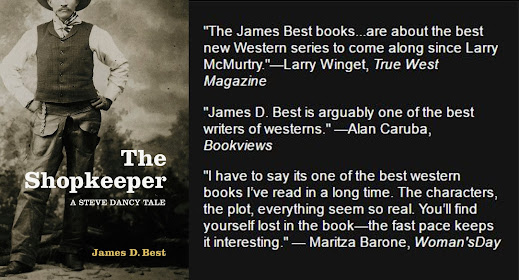
Free Kindle Edition of The Shopkeeper, A Steve Dancy Tale

Honest westerns. Full of dishonest characters.

As a promotion for the soon to be release of Old Haunts, The Shopkeeper ebook will be free from April 24th through the 28th. If you haven't started this great series, go grab yourself a copy of the first book of eight Steve Dancy Tales.


Tuesday, April 11, 2023

Lincoln Book Review: The Trent Affair


The Trent Affair: The Diplomatic Incident that Nearly Brought Great Britain into the American Civil War

The Trent Affair claims historians pay the Affair short shrift, then promises to deliver new revelations about this diplomatic incident. The books primary value is quoting first source letters, newspaper articles, and official documentation. It is always useful to read first source material, but those presented do not provide a different perspective than historians have depicted. Granted, historians gloss over the nuts and bolts of the Affair, but it’s because the issue was resolved before it could impact the course of the conflict.

What if the Trent Affair hadn’t been agreeably settled. If Great Britain had entered the war on the Confederacy’s side, it was likely that the South would have won. That would have made the Trent Affair a huge deal. Jefferson Davis’s top diplomatic priority was to drag a European power into combat. Abraham Lincoln’s top diplomatic priority was to deny the Confederate States of America recognition by European powers. This book did not provide additional insights on how Lincoln outsmarted Davis. As you study the Affair, there are hints of backroom bartering but no evidence. When desired, Lincoln was fairly astute at maneuvering without leaving fingerprints.

This is an odd little book with poor transitions and scant narrative about quoted material. The photographs of the major participants are well known. In the end, the book added little understanding to this diplomatic fiasco. A pity because handled differently, the Trent Affair could have been the linchpin to the entire conflict.


Saturday, April 1, 2023

Lincoln Book Review: The Shut Mouth Society


The Shut Mouth Society is my own Lincoln book. This modern day thriller is a typical chase novel à la Robert Ludlum. The Ludlum formula for this genre has a man and woman oddly meet to be accused of a crime and then chased by good guys and bad guys until they save themselves by unraveling a mystery that threatens social order. In my book, the mystery is a secret society formed after the Civil War that threatens to take control Mexico. The chase is launched when a small town police chief and renowned professor are asked to assess the validity of a pre-presidential document in Lincoln hand. Abe Lincoln is interwoven throughout the story as they must examine his life and motivations to solve the mystery.

I had done an enormous amount of research on Lincoln to craft an exciting story that was also historically accurate. These are book reviews but I’m too biased to rate The Shut Mouth Society as a work of fiction. (However, 405 Amazon readers have given it an average rating of 4.3 and the book was a finalist is the APA Glyph Awards for Best Novel.) This reading was to revisit my Lincoln research for my historical novel Maelstrom. I found no substantive errors. (However, if a set of dialogue begins with something like, “Some historians believe,” then what follows is not necessarily true. It only means that some credentialed authors believe it true. I believe I wrote the story in a manner where a reader will have no difficulty separating historical fact from speculation.)

All of that said, I believe The Shut Mouth Society is a fun way for readers to enjoy a rousing story and obtain a better understanding of our sixteenth president.


Thursday, March 30, 2023

Old Haunts Enters Proofreading


Interim Book Cover


Old Haunts, A Steve Dancy Tale has entered the proofreading stage. The new Steve Dancy should be available in 4-6 weeks. Thank you for your patience. Here's a snippet to whet your appetite.

“You be Steve Dancy?” asked a man behind my shoulder.

I looked up to see a lean, shallow-cheeked youth in his early twenties who appeared earnest. Earnest about what, I wondered.

“Do I know you?” I asked.

“Nope. But I heard of you. Deadly gunman. Rich as Midas. Renown throughout the West as one of the few surviving gunfighters.”

 “You forgot author. I write novels.” I laughed. “Sorry, son, those are just stories.”

“Not from what I hear. They say you write about yourself.”

I tried a friendly smile. “If only that were true. Actually, the life of a writer is exceptionally dull. Sitting in front of an Underwood all day. How’d you recognize me anyway.”

“I got my ways. I came over see if we could arrange a duel.”

“A duel? Is this a joke? I’m not a duelist. I’m a writer and a businessman. My characters duel, I don’t.”

“No joke.” He gave me a hard stare that reminded me of someone I couldn’t place. “I demand a duel.”

“Demand to your heart’s content, I’m not responding. I’m a married man with a quiet home and three kids. You’ve been misinformed.”

“Being a father ain’t no excuse. You killed my pa.” When I didn’t respond, he added, “Name of Brian Cutler.”

“Never heard of him,” I lied.

“Oh, yes you have. Without warning, you shot him and my uncle dead in the streets of Pickhandle Gulch.”

I stared in disbelief. Brian Cutler had been the first man I killed. Or the second. His brother may have been first. I didn’t remember.

Honest westerns.  Filled with dishonest characters.


Thursday, March 23, 2023

Lincoln Book Review: The Myth of the Lost Cause Vs. The Real Lincoln


This post deals with two books on the “Lost Cause.”

Thomas J. DiLorenzo presents the case for the Lost Cause in The Real Lincoln: A New Look at Abraham Lincoln, His Agenda, and an Unnecessary War, while Edward H. Bonekemper argues against the Lost Cause in The Myth of the Lost Cause: Why the South Fought the Civil War and Why the North Won.

What is the Lost Cause? The basic tenants are as follows: the War of Northern Aggression had nothing to do with slavery; the South did nothing to provoke war; the Constitution included a right to secede and the South should have been allowed to leave peacefully; antebellum life in the South was prosperous, dignified, and just; slavery was already dying; Robert E. Lee deserved deification, U. S. Grant deserved demonization, the North deserves condemnation for engaging in total war; the South had no chance of winning, and most important of all, Lincoln was a despot who started the war by invading South. 

Basically, the Lost Cause is innocence victimized.

I chose these two specific books because they are both relatively recent (2003 and 2015) and each author presents their respective positions clearly, with entertaining gusto. On which side of this controversy did I land? You can probably guess, but this argument has raged for over one hundred and fifty years and these books will provide all the information you need to make up your own mind.

(These are research books for Maelstrom, a sequel to Tempest at Dawn.)

Monday, March 20, 2023

Is Mexican drug trafficking really our fault?


The president of Mexico, Andrés Manuel López Obrador, recently claimed that the American fentanyl epidemic was caused by “a lack of hugs, of embraces.” Cute that, but nothing new. Whenever the subject of drug trafficking comes up, Mexico throws its arms wide and pleads innocent. The spokespeople for Mexico tell us the problem is in our own backyard. We consume drugs at a prodigious rate, so demand is the issue, not supply.

To listen to them explain it, we’re not only at fault for drug trafficking, but American druggies are responsible for all the drug related carnage in Mexico as well. The journalists killed this year in Mexico? Our fault. The one hundred thirty-two Mexican politicians killed in 2018? Our fault. The seventy-five American tourists murdered in Mexico in 2016? Our fault. The fourteen people killed in a thirty-six-hour period in Cancun? Our fault. The thousands of Mexican civilians killed each year by drug gangs? Our fault.

And what about the million plus deaths by overdose in America since 2000 and the million annual Emergency Room visits involving illicit drugs?

Definitely our fault.

This deflection always sounded hollow to me. These Mexican shills basically claim that we can’t complain about the drug cartels until we clean up the demand side. Except. Do they really believe that American teenagers wake up one morning and say hey, that drug thing, I'm gonna get into that? Do they really believe that the drug cartels are merely reacting to an organic demand for opioids? If we behave on our side of the border, then all will be copacetic, and the bad guys will retreat to a legitimate business? Do they really expect us to believe that line of bullshit?

They do … and we do. When pummeled with alleged culpability, Americans are too willing to blame themselves for others’ transgressions.

Here’s why I don’t buy it. The drug cartels have an expansive salesforce trained on how to seduce our kids. For the most part this sales force is American, but make no mistake, they are employees of the cartels. And there’s an army of them. A big army. They do the cartel’s bidding and they do it to a honed script. A party with drinking? Allow the partygoers to get a little drunk and then offer free samples. Hey, try this, it’s fun. Guys, you want girls? Use this. Scared of local thugs? Join our gang and survive with the benefit of getting high for cheap. Clubbing? Concerts? Sex? Go high. You’ll enjoy it more.

Once hooked, the cartel salesforce reels them in. You need more? No money? No problem. Get me a referral and I’ll give you a freebee. Still need more? You can pay by selling for me at your school … or maybe, hey, sell your body.

Now imagine a United States without this encouraged demand. Drug free? No, but a much smaller problem, with fewer gang related deaths. Gang violence is nothing more than the Mexican cartel wars exported along with their drugs into the United States.

What if we made all drugs legal? That’s how we got fentanyl, the deadliest of all the illicit drugs. With marijuana becoming increasingly legalized, the cartels had to find a new product to fill their established supply lines. Fentanyl is 35 times stronger than heroin. (And they told us legalizing Marijuana would reduce the drug problem.) Legalize fentanyl and the cartels will move something even stronger because the organizational apparatus is in place, and it requires duffle bags of cash to keep it running.

What’s the answer? We must shut down the supply line. In toto. Build The Wall and get ready for the cartels to sneak in by sea or air. Get very tough with Mexico. Force them to help us. We must stop this poison from entering the United States, and enforce domestic laws to arrest the cartel’s neighborhood sales force. Law enforcement needs to stop trying to move up the management chain and start putting the street vendors behind bars. The cartels cannot move their product without a domestic sales force, and they have a prodigious appetite for cash. Dry up their cash flow and their empires will start to crumble.

You can play with the demand side until your kid’s heart stops. It will do no good. It’s time to go after the supply.

Shut it down. Completely.


Wednesday, February 8, 2023

Lincoln Book Review: Lincoln by Gore Vidal


I’m not a Gore Vidal fan. I thought Burr was a hash, especially from a historical perspective. Lincoln is a better novel, but still blemished due to Vidal’s penchant for showing off. A novel is a story, and the cardinal rule of storytelling is to never jerk the reader out of the story, but Vidal continuously interrupts his characters mid-scene to take a bow. Witty asides, overly clever dialogue, meaningless gossip, and focus on the trivial when the reader yeans for the big picture, are bad enough, but the near absence of transitions is jarring. Vidal goes from one scene to another with a whole different cast of characters without even a “by your leave.” It is like, “Hey, I veered off over here, catch up.” And you do, but it takes the rereading several sentences. By then the magic is gone.

The book is titled Lincoln, but Ol’ Abe comes across as a side character. He is explained by countless others that surround the supposed protagonist. Most of these characters come across as untrustworthy narrators. Characterization is not a Gore Vidal strong suit. Everyone seems similar and each carries a little of Vidal’s rapscallion nature. Vidal likes rogues, scoundrels, and outright villains and ascribes his characters' motivations to the dark side of human frailty.

Some historians have taken issue with the historical accuracy of Lincoln. As a historical novelist, I know strict adherence to facts presented in their proper order does not always lend itself to good storytelling. In this readers opinion, Vidal’s may skew events and people to his viewpoint but, for the most part, his violations are inconsequential. This is a well-researched book and Vidal’s relaying of events, large and miniscule, is generally accurate.

If you prefer history presented as a story, Lincoln is the best novel about Lincoln available ... until I publish Maelstrom.


Saturday, November 5, 2022

Lincoln Book Review: A Patriot’s History of the United States


A Patriot’s History of the United States

From Columbus’s Great Discovery to the War on Terror

Larry Schweikart, Michael Patrick Allen


From the subtitle, it would be easy to assume A Patriot’s History is a breezy treatment of our nation’s history. From the title, it might also be assumed that this is a polemic tomb. Neither would be correct. To accommodate five centuries of history in a single volume, each episode must be tersely described, but terse does not necessarily mean unacademic. Schweikart and Allen do a superb job of describing the essence of a historic moment without being superficial. Although the authors freely admit to a belief in conservative principles, the book is not a conservative rewriting of history through creative description or omission. The authors do not gloss over some of our uncomfortable past or whitewash occasional spells of truly bad behavior. All in all, this is an excellent survey of American history.

These book reviews have focused on the Civil War and the principal players in that conflict. A Patriot’s History covers much more ground. I had read the book when it first came out and recently reread the two chapters dealing with the Civil War. When lost in the trees, it’s helpful to get a perspective on the forest This book reminded me to always keep an eye the big picture.

I would recommend A Patriot’s History as a reference book or to read cover to cover.

Thursday, September 15, 2022

The Myth of Voter Suppression, The Left’s Assault on Clean Elections By Fred Lucas


The Myth of Voter Suppression exposes the imbalance between the voter suppression and voter fraud controversies. Although Lucas cites examples of voter suppression in our past, today, voter suppression is a myth. Voter suppression is illegal, minority voting is statistically growing, and extremely few cases of voter suppression have been adjudicated. On the other hand, Lucas demonstrates that voter fraud is real and has a long history in this country.

My favorite historical episode of fraud goes back to the Civil War. For the first time, soldier were allowed to vote by mail. On September 27, Ulysses S. Grant wrote to the Secretary of War: “The exercise of the right of suffrage by the officers and soldiers of armies is a novel thing. A very large proportion of legal voters of the United States are now either under arms in the field, or in hospitals, or otherwise engaged in the military service of the United States … they are American citizens, having still their homes and social and political ties binding them to the States and districts from which they come … In performing this sacred duty they should not be deprived of a most precious privilege. They have as much right to demand that their votes shall be counted in the choice of their rulers as those citizens who remain at home.”

New York Democrats saw an opportunity to use fraudulent votes to defeat Abraham Lincoln. Lucas relates how McClellan’s supporters used forged names and signatures on crate after crate of fake ballots that supposedly came from soldiers. One conspirator even said, “Dead or alive, they all had cast a good vote.” The vote fraud conspirators in this particular case were sentenced to life imprisonment. 

Despite the preponderance of voter fraud being perpetrated by the Democratic Party, many Democrats claim voter fraud is nonexistent or so rare that it’s inconsequential. HR1 demonstrates otherwise. The Democratic Party leadership tried desperately to pass a nationwide voting law that would make cheating easy ... and an easy way to amass or hold political power would unquestionably lead to fraud and the destruction of our republican form of government. Prior to reading The Myth of Voter Suppression, I didn’t know the devilish details of HR1, the “For the People Act.” The name is the exact opposite of the bill’s intent. If properly named, HR1 would be called the “For the Politicians Act.” Lucas’ chapter, “Legalizing Fraud through Voter Rights Legislation” ought to be required reading for every registered voter. Any politician that supports HR1, or one of its derivatives, does not believe that the citizens of this nation should be allowed to pick their leaders. 

This is a well-researched book on a very important subject. I highly recommend it.  

Monday, August 15, 2022

Desperate Engagement by Marc Leepson


A lot happened between July 9th and the 12th in 1864. Marc Leepson has made this short period of the Civil War the focus of his book Desperate Engagement: How a Little-Known Civil War Battle Saved Washington D. C., and Changed American History.

In the end, the battle changes little other than perhaps delaying the end of the war. General Grant continued his stranglehold on the Confederate Army surrounding Richmond until Lee surrendered at Appomattox. Nonetheless, if the Hail Mary pass had been completed and General Jubal Early had sacked Washington, we might be all speaking with a Southern accent. 

It was close. Heart-stopping close.

The risky moves and countermoves, potential payoff, and unbridled heroism on both sides should have made this an exciting book. The Battle of Monocacy and attempted siege are nicely covered in about four or five chapters with the remaining chapters filled mostly with letters and memoirs of the participants, asides, or research factoids. Civil War buffs should find even the trivia interesting, but a casual reader might view much of this text as fill.

Monday, August 8, 2022

Best Commentaries

Based Opinions with a Dash of Cinnamon


I started my writing career as a magazine columnist. No, not political opinions. My columns were about computer technology. My first book, The Digital Organization, was also a nonfiction, computer technology book. Then I lost control of my senses and wrote Tempest at Dawn, a novelization of the Constitutional Convention. Big subject, big book. And big surprise. I loved storytelling. Been at it ever since, and I have now written eleven novels and several short stories.

Tempest at Dawn, my first novel, brought me some unexpected attention. I had a few scary national television appearances and some surprise endorsements. It also brought me invitations to write for Constituting America and What Would The Founders Think? Soon I was in the thick of political blogging. Along the way, I also wrote for RedState and The American Thinker. It should be obvious from names of these sites that I wrote from a conservative perspective, so, fair warning, Best Commentaries is a collection of conservative opinion pieces.

Here’s a sampling.

We often hear laments that our politicians no longer honor their pledge to preserve, protect and defend the Constitution of the United States. This is backward. The Constitution was not written for politicians. Our political leaders have no motivation to abide by a two hundred year old restraining order. Americans must enforce the supreme law of the land. The first outsized words of the Constitution read We the People. It’s our document. It was always meant to be ours, not the government’s. It is each and every American’s obligation to preserve, protect, and defend the Constitution of the United States.

                                                                        ***

Democrats are disappointed because past campaigns did not go the way they wanted. Occupy Wall Street did not incite class warfare, Black Lives Matter did not start a race war, and Antifa did not expose a vast cadre of neo-Nazis lurking in the background.

                                                                        ***

If you lay every economist in the world end to end, you still won’t reach a conclusion. If you want to carry out bad economic policy, it’s not difficult to find a tenured professor to provide the rationalization. Roosevelt, Carter, Obama, and Biden have all applied disproven Keynesian principles … to the same result. Now, remind me, what was the definition of insanity again?

                                                                        ***

Proponents of Big Government used different nomenclatures to describe their ideal system, but they all have one overriding characteristic—power centralized in government. Socialism, fascism, communism, feudalism, monarchies, dictatorships, theocracies, police states, a unitary state, oligarchies, et. al. concentrate power in the state. The underlying political theology is irrelevant. In each and every case, the individual is subject to control by the state. It doesn’t matter who orders you about. It could be a king, emperor, dictator, a party general secretary, or an elected machine politician. The result is the same. You do as you’re told.

                                                                        ***

The United States of America is exceptional, but we are not exceptional because we are a different people. People are the same the world over. We are exceptional because of the uniqueness of our founding. The Declaration of Independence and United States Constitution were not events. They were processes that took many years to come to fruition. They both engaged an entire nation. They both were guided by clear principles. They both reflected timeless truths that inspired us to move ever closer to greatness.


You can order an e-book, paperback or hard cover at Amazon or order a print version from your local book store. 

If you like it, tell everyone. If you don't, mum's the word.

Thursday, July 21, 2022

Abraham Lincoln, by Lord Charnwood


Lord Charnwood published Abraham Lincoln in 1916. In order to get a clearer perspective of the Civil War, it helps to read books from multiple viewpoints. Lord Charnwood wrote only fifty years after the war, bringing an almost contemporaneous perspective to his depictions. His biography has the advantage of proximity but with enough time elapsed to dampen the passions of the moment. More important, as an English depiction, it is a simultaneously a distant point of view. It is a distance of more than nautical miles. Lord Charnwood also brings the bias of English nobility to his descriptions. This is exceptionally important in gaining an understanding of the diplomatic imperative for both sides. The Confederacy desperately sought European recognition of their legitimacy, while Lincoln did everything in his power to deny international recognition and suppress arms and funding from abroad. Lincoln’s success was arguably pivotal to eventually making victory possible.

 Abraham Lincoln, by Lord Charnwood can be a tough read. A simple, declarative sentence is beyond the baron. This is partly due to the style of the times and partly the way of academics who feel a need to qualify every utterance. Once the reader adjusts to the wordily writing, nuggets of rare perspective make the effort well worthwhile. For example, Thomas Jefferson is not one of my favorite Founders and Lord Charnwood seems to have shared some of my reservations. He also makes other political observations that an American might be reluctant to express.

If you have an interest in the mid-nineteenth century, Abraham Lincoln by Lord Charnwood can be an enlightening read.