Tuesday, June 2, 2020

Abraham Lincoln's Address at Cooper Union -- Constitutional Chats

Constituting America

Watch a video of Constitutional Chat with yours truly as guest.

What was so great about his speech at the Cooper Union? It was earth-moving because it was highly unusual. It was a call for his party to stand on principle—God’s principles, the Founders’ principles, and the founding principle of the Republican Party—the abolition of slavery.


Thursday, April 30, 2020

February 27, 1860: Abraham Lincoln Delivers His Cooper Union Address


On the evening of February 27, 1860, New Yorkers paid an exorbitant twenty-five cents to listen to a commonplace politician from some prairie state. The man had a reputation as a storyteller extraordinaire. Everyone expected to be entertained; few took the speaker seriously as a presidential candidate. Abraham Lincoln had earned a modicum of fame due to his debates with Senator Stephen Douglas two years previously, but he had lost that race and most believed the fledgling Republican Party would never nominate a loser. In fact, many wondered how this roughhewn storyteller wangled an invitation to a lecture series meant to expose serious candidates to the New York elite? Homespun yarns might draw crowds in the bucolic West, but New York City demanded a more elevated style of speechmaking.

Monday, April 13, 2020

Guest appearance on Constitution Chat


Constitutional Chats hosted by Janine Turner & Cathy Gillespie

Actress Janine Turner, Cathy Gillespie and Constituting America’s Student Ambassadors chat with experts on hot-topic issues. I'll be interviewed on Saturday, April 18, at 9:00 PM ET. The subject will be my forthcoming essay on Lincoln's Cooper Union Address.
On the evening of February 27, 1860, New Yorkers paid an exorbitant twenty-five cents to listen to a commonplace politician from some prairie state. The man had a reputation as a storyteller extraordinaire. Everyone expected to be entertained; few took the speaker seriously as a presidential candidate.


Tuesday, March 17, 2020

December 15, 1791: Bill of Rights of the United States Constitution Are Ratified


Bill of Rights


Despite a modern perception that the first ten amendments bestow rights, it’s clear that the Bill of Rights is really a list of government prohibitions. The Founders did not believe in government benevolence and would never have accepted government as the arbiter of rights. 

Read all about it at Constituting America


Tuesday, March 10, 2020

Guest essayist at Constituting America: U.S. Constitution Sent to the States for Ratification


Constituting America


The Founding of this great nation was unique. Until 1776, with a few brief exceptions, world history was about rulers and empires. The American experiment shook the world. Not only did we break away from the biggest and most powerful empire in history, we took the musings of the brightest thinkers of the Enlightenment and implemented them. Our Founding was simultaneously an armed rebellion against tyranny, and a revolution of ideas—ideas that changed the world.
That is why we still care about America’s founding and the Framers of our Constitution.

Monday, February 17, 2020

Constituting America: 2020 90-Day Study Launches


I'll be participating again this year. I'll let you know when my essays are published, but in the meantime, take a gander at this.


"Many Americans, including perhaps a majority of young people, believe that the present is so different from the past that the past no longer has anything to teach us. This could not be more wrong." Dr. Wifred McClay, from the Introduction.

Sunday, February 9, 2020

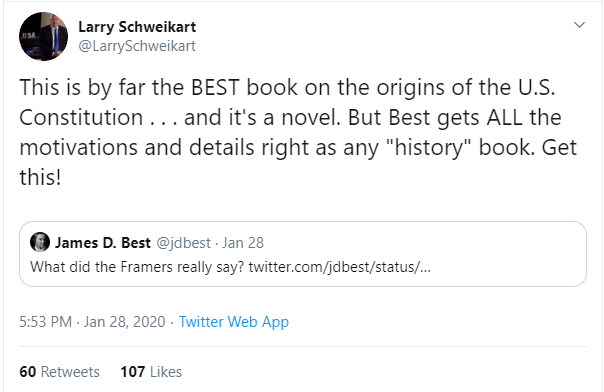
Nice Endorsement for Tempest at Dawn


Who is Larry Schweikart? He’s not only a history guru, he’s a tenured college professor, who once lectured in the halls at the University of Dayton. There, he taught history for 20 years and literally “wrote the book” on the subject. A Patriot’s History. Actually 25 books and counting. Many, New York Times #1 best sellers.

Larry Schweikart books on Amazon

Thanks for the kind words, professor.

Sunday, January 12, 2020

A Republic, if You Can Keep It . . .

I pledge allegiance to the flag of the United States of America, and to the Republic for which it stands, one Nation under God, indivisible, with liberty and justice for all.

At the close of the Constitutional Convention of 1787,  Franklin was queried as he left Independence Hall on the final day of deliberation. In the notes of Dr. James McHenry, one of Maryland’s delegates to the Convention,  a lady asked Dr. Franklin “Well Doctor what have we got, a republic or a monarchy.”  Franklin replied, “A republic . . . if you can keep it.”

Our Constitution created a limited representative republic.  A republic is different from a democracy.  In a democracy, the majority can directly make laws, while in a republic, elected representatives make laws.  Basically, in a pure democracy, the majority has unlimited power, whereas in a republic, a written constitution limits the majority and provides safeguards for the individual and minorities.
In the United States, we actually have both systems.  There is no way for Americans to directly enact legislation at the national level, but half of the states allow ballot initiatives which, if passed by a majority of the voters, have the force of law.
The Founders’ intent at the national level was a representative republic.  The word democracy is not mentioned in the Constitution.   Most of the Founders distrusted pure democracy.  Some had been frightened by Shays Revolt and equated democracy with mob rule. Others were convinced by Madison that different factions would come together until they formed a majority, and then take advantage of those who were not members of their coalition. In fact, Madison showed that throughout history, this phenomenon had destroyed every experiment in democracy.
John Adams wrote that “There never was a democracy yet that did not commit suicide,” and James Madison wrote in Federalist 10 that “Democracies have, in general, been as short in their lives as they have been violent in their deaths.” The reason pure democracies fail is that majorities learn that they can legally take property and/or liberties away from others. Those subjected to abuse can be anyone outside the majority coalition, and their minority status can be based on race, religion, wealth, political affiliation, or even which city or state they reside in. Demagogic leaders become adept at appealing to the emotions of jealousy, avarice, and entitlement. They also denigrate opponents in order to justify prejudicial actions taken by the majority.  Soon, oppression of minority classes causes enough conflicts to collapse the democratic process.
A major difference between a republic and a democracy is immediacy. The Founders wanted laws made by representatives in order to put a buffer between popular passions and legislation. In a democracy, decisions are made in the heat of the moment, while periodic elections in a republic provide a cooling off period. To a great extent, democracies are ruled by feelings, while in a republic, the rule of law governs. In a republic, politicians can take principled actions that go against the will of many of their constituents with the knowledge that they will be judged by all the actions they take during their entire term in office. Political leaders are also given time to explain the reasons for their actions.

Of course, if an elected official does something grievously offensive, then the voters can follow the advice of Alexander Hamilton, who in Federalist 21 wrote, “The natural cure for an ill-administration, in a popular or representative constitution, is a change of men.” 
When the people’s will is thwarted, regular elections give them the opportunity to dismiss their representatives and appoint new ones.

Monday, December 16, 2019

Happy Birthday To The Bill Of Rights! 228 Years of Protection


Buy at Constituting America


Is our Bill of Rights a list of government-guaranteed rights? Absolutely not. The first eight amendments are filled with phrases like, “Congress shall make no law, shall not be infringed, shall not be violated, nor be deprived, shall not be required.” These are not a list of rights generously bestowed by a benevolent government. Instead they are a list of restrictions on government. As a safety measure, they added the caveat that this was not a complete list (IX Amendment).

Rights endowed by God was not a new concept. It went back at least to Marcus Tullius Cicero and the Roman Republic. Cicero searched for what he called natural law. Marcus Tullius Cicero (106 BC–46 BC) on Natural Rights: 
True law is right reason in agreement with nature; it is of universal application, unchanging and everlasting. There will not be different laws at Rome and at Athens, or different laws now and in the future, but one eternal and unchangeable law will be valid for all nations and all time. If so great a power belongs to the decrees of fools that the laws of Nature can be changed by their votes, then why do they not ordain that what is bad be considered good?

John Locke and the Enlightenment magnified awareness that rights came from God. Locke wrote that humans were “by nature free, equal and independent.” Our First Congress wrote these rights as amendments to the Institution and the states ratified the ten amendments we call the Bill of Rights.

Happy Birthday to the Bill of Rights 


Here are two great articles on the Bill of Rights from Constituting America

The Bill of Rights: America's Bulwark of Liberty by Horace Cooper, Constituting America Fellow

Happy Bill of Rights Day by Tony Williams, Constituting America Fellow


Wednesday, December 11, 2019

Perfect Gift for Constitution Enthusiast


The real story of our nation's founding.


Christmas gift idea holiday gift
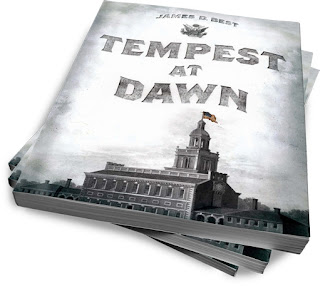
Tempest at Dawn


"The best novel EVER on the U.S. Constitution."—Larry Schweikart, author A Patriot's History of the United States and over a dozen other history books

"I find hope and confidence in the wonderfully written Tempest At Dawn, by James D. Best" Allen Ball, Beaufort Observer

"The novel captures the real drama that ensued behind closed doors as they hammered out what is now the oldest living constitution and the foundation of the nation. Read it for its historical value. Read it for its dramatic value. But read it!"—Alan Caruba, Bookviews

"Thanks to James Best’s masterpiece, Tempest at Dawn, I felt like the 56th delegate at the Constitutional Convention. Using vivid narrative and expressive dialogue, Tempest at Dawn presents all the major issues the Founding Fathers struggled with."—Michael E. Newton, author of Alexander Hamilton and other history books.

"This book was absolutely fabulous. If you want a terrific historical fiction book, I recommend you start with this one." Selbrede 40 Book Challenge

"This is an important story told in a lively fashion. Tempest at Dawn might be the ideal way of introducing the American public to the gripping story of how our Founding Fathers gave birth to our constitution."—Jon Bruning, Attorney General, Nebraska


Wednesday, November 20, 2019

Alexander Hamilton has a Warning for the Nation


In mid-June, Alexander Hamilton made a speech at the Constitutional Convention. This was early in the process and the Framers were still feeling their way toward a solution. His words have relevancy to our modern political situation. The emotional plea for impeachment has resulted in a public relations battle between the interested parties. If one side can get the poll numbers to slide in their direction, they win. Both sides have come to believe passion, not evidence of wrongdoing will determine the outcome.

Excerpt from Tempest at Dawn
Gentlemen, I’m unfriendly to both the New Jersey plan and the Virginia plan. Both deliver mere pork with different sauces. Neither considers the amazing turbulence of the democratic spirit. When a popular passion seizes people, it spreads like wildfire. In every society there’ll be a division of people into the few and the many. Give all power to the many and they oppress the few. Give all power to the few and they oppress the many. We’re now watching uncontrolled passion destroy this great country. The Union is dissolving.”

Saturday, October 19, 2019

James Madison warning against democracy at the Constitutional Convention


Recently, there's been a lot of blathering about how our country should become more democratic. There is special fury aimed at the Electoral College. One conservative defense is that the Framers never intended the United States to be a pure democracy. Many times this rational is thrown up without explaining why the framers believed democracy destroyed liberty. Since James Madison has been referred to as the Father of the Constitution, I'll let him explain the dangers of  democracy. 


(As a background note, at the time of the Constitutional convention, Madison didn't technically own slaves. His father owned Montpieler and its slave labor force. This is not an excuse, but an explaintion of why he might have felt free to use slavery to illustrate his point.)


Madison made comments similar to the following on June 6th, 1787.


Excerpt from Tempest at Dawn

Madison made a few more comments on the role of the national government but then could not contain himself. Without preamble, Madison charged into new terrain. “Gentleman, all societies divide into different sects, factions, and interests. Conflicts grow between the rich and poor, debtors and creditors, landed and commercial interests, this district against that district, followers of this political leader or that political leader, disciples of this religion or that religion.

“When a majority unites by passion or common interest, the minority is in grave danger. What can restrain a majority? Not respect for others, nor conscience. In Greece and Rome, the patricians and plebeians alternately oppressed each other—with equal ferocity. We’ve seen the mere distinction of color, in our supposed enlightened time, furnish the grounds for the most oppressive dominion ever exercised by man over man.”

With this last, startled gasps escaped from various corners of the room. Madison tried to ignore the reaction. His indictment of slavery had been unpremeditated, but now that it had escaped his lips, he couldn’t recall it.

“Who imposed these unjust laws? The majority. Debtors defraud creditors. The holders of one type of property throw a heavier tax on other types of property. When a majority has the opportunity, they will always threaten the rights of the minority.” Madison shifted his gaze across the sea of delegates. “Make no mistake, in a republic, the majority always has opportunity!”


https://amzn.to/2P3geK2
The real story of our nation's founding.