| Abraham Lincoln: The Boy The Man by LLoyd Ostendorf |
“The infant periods of most nations are buried in silence, or veiled in fable, and perhaps the world has lost little it should regret. But the origins of the American Republic contain lessons of which posterity ought not to be deprived.” —James Madison
| Abraham Lincoln: The Boy The Man by LLoyd Ostendorf |
Abraham Lincoln and The Second American Revolution by James M. McPherson
This book is a collection of seven essays on the Civil War. Originally,
these essays were lecture notes. They are well written and thoughtful. The
common theme is that the Civil War was a second revolution because it resulted
in revolutionary transformations of the country and was accompanied by a
counter-revolution a couple decades after Appomattox. Each essay covers a
single premise and can be read separately.
Slavery divided the nation in 1787 and severed the nation in
1860. Many have said that the Civil War settled the key issue kicked down the
road by the Constitutional Convention. Did the Civil War finish the Founders’
work or was it in and of itself revolutionary? Read Abraham Lincoln and The
Second American Revolution and decide for yourself.
Ending slavery in the United States was horrendously
difficult. It took a four year war with about 620,000 deaths. The politics were
byzantine and the warfare brutal. Reunification was even more ferocious, and absent
Lincoln, the backsliding undid much of the accomplishment.
In the end, I found this to be a sad book.
![]() |
| Honest westerns. Full of dishonest characters. |
Old haunts is now available in hardcover, trade paperback, and Kindle. Get a copy while they're still hot off the press.
![]() |
| Honest westerns. Full of dishonest characters. |
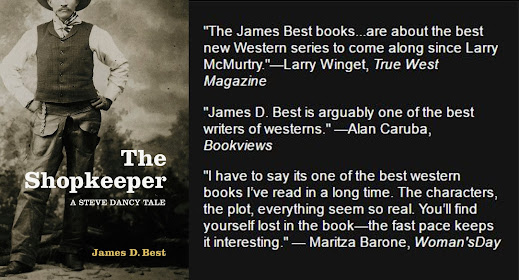
As a promotion for the soon to be release of Old Haunts, The Shopkeeper ebook will be free from April 24th through the 28th. If you haven't started this great series, go grab yourself a copy of the first book of eight Steve Dancy Tales.
The Trent Affair claims historians pay the Affair short shrift, then promises to deliver new revelations about this diplomatic incident. The books primary value is quoting first source letters, newspaper articles, and official documentation. It is always useful to read first source material, but those presented do not provide a different perspective than historians have depicted. Granted, historians gloss over the nuts and bolts of the Affair, but it’s because the issue was resolved before it could impact the course of the conflict.
What if the Trent Affair hadn’t been agreeably settled. If
Great Britain had entered the war on the Confederacy’s side, it was likely that
the South would have won. That would have made the Trent Affair a huge deal. Jefferson
Davis’s top diplomatic priority was to drag a European power into combat.
Abraham Lincoln’s top diplomatic priority was to deny the Confederate States of
America recognition by European powers. This book did not provide additional
insights on how Lincoln outsmarted Davis. As you study the Affair, there are
hints of backroom bartering but no evidence. When desired, Lincoln was fairly astute
at maneuvering without leaving fingerprints.
This is an odd little book with poor transitions and scant narrative
about quoted material. The photographs of the major participants are well known.
In the end, the book added little understanding to this diplomatic fiasco. A
pity because handled differently, the Trent Affair could have been the linchpin
to the entire conflict.
![]() |
| Interim Book Cover |
“You be Steve Dancy?” asked a man behind my shoulder.I looked up to see a lean, shallow-cheeked youth in his early twenties who appeared earnest. Earnest about what, I wondered.“Do I know you?” I asked.“Nope. But I heard of you. Deadly gunman. Rich as Midas. Renown throughout the West as one of the few surviving gunfighters.”“You forgot author. I write novels.” I laughed. “Sorry, son, those are just stories.”“Not from what I hear. They say you write about yourself.”I tried a friendly smile. “If only that were true. Actually, the life of a writer is exceptionally dull. Sitting in front of an Underwood all day. How’d you recognize me anyway.”“I got my ways. I came over see if we could arrange a duel.”“A duel? Is this a joke? I’m not a duelist. I’m a writer and a businessman. My characters duel, I don’t.”“No joke.” He gave me a hard stare that reminded me of someone I couldn’t place. “I demand a duel.”“Demand to your heart’s content, I’m not responding. I’m a married man with a quiet home and three kids. You’ve been misinformed.”“Being a father ain’t no excuse. You killed my pa.” When I didn’t respond, he added, “Name of Brian Cutler.”“Never heard of him,” I lied.“Oh, yes you have. Without warning, you shot him and my uncle dead in the streets of Pickhandle Gulch.”I stared in disbelief. Brian Cutler had been the first man I killed. Or the second. His brother may have been first. I didn’t remember.
![]() |
| Honest westerns. Filled with dishonest characters. |
This post deals with two books on the “Lost Cause.”
Thomas J. DiLorenzo presents the case for the Lost Cause in The Real Lincoln: A New Look at Abraham
Lincoln, His Agenda, and an Unnecessary War, while Edward H. Bonekemper
argues against the Lost Cause in The Myth
of the Lost Cause: Why the South Fought the Civil War and Why the North Won.
What is the Lost Cause? The basic tenants are as follows: the War of Northern Aggression had nothing to do with slavery; the South did nothing to provoke war; the Constitution included a right to secede and the South should have been allowed to leave peacefully; antebellum life in the South was prosperous, dignified, and just; slavery was already dying; Robert E. Lee deserved deification, U. S. Grant deserved demonization, the North deserves condemnation for engaging in total war; the South had no chance of winning, and most important of all, Lincoln was a despot who started the war by invading South.
Basically, the Lost Cause is innocence victimized.
(These are research books for Maelstrom, a sequel to Tempest at Dawn.)
To
listen to them explain it, we’re not only at fault for drug trafficking, but
American druggies are responsible for all the drug related carnage in Mexico as
well. The journalists killed this year in Mexico? Our fault. The one hundred
thirty-two Mexican politicians killed in 2018? Our fault. The seventy-five
American tourists murdered in Mexico in 2016? Our fault. The fourteen people
killed in a thirty-six-hour period in Cancun? Our fault. The thousands of
Mexican civilians killed each year by drug gangs? Our fault.
And
what about the million plus deaths by overdose in America since 2000 and the
million annual Emergency Room visits involving illicit drugs?
Definitely
our fault.
This
deflection always sounded hollow to me. These Mexican shills basically claim
that we can’t complain about the drug cartels until we clean up the demand
side. Except. Do they really believe that American teenagers wake up one
morning and say hey, that drug thing, I'm gonna get into that? Do they really
believe that the drug cartels are merely reacting to an organic demand for
opioids? If we behave on our side of the border, then all will be copacetic,
and the bad guys will retreat to a legitimate business? Do they really expect
us to believe that line of bullshit?
They
do … and we do. When pummeled with alleged culpability, Americans are too
willing to blame themselves for others’ transgressions.
Here’s
why I don’t buy it. The drug cartels have an expansive salesforce trained on
how to seduce our kids. For the most part this sales force is American, but
make no mistake, they are employees of the cartels. And there’s an army of
them. A big army. They do the cartel’s bidding and they do it to a honed
script. A party with drinking? Allow the partygoers to get a little drunk and
then offer free samples. Hey, try this, it’s fun. Guys, you want girls? Use
this. Scared of local thugs? Join our gang and survive with the benefit of
getting high for cheap. Clubbing? Concerts? Sex? Go high. You’ll enjoy it more.
Once hooked, the cartel salesforce reels them in. You need more? No money? No problem. Get me a referral and I’ll give you a freebee. Still need more? You can pay by selling for me at your school … or maybe, hey, sell your body.
Now imagine a United States without this encouraged demand. Drug free? No, but a much smaller problem, with fewer gang related deaths. Gang violence is nothing more than the Mexican cartel wars exported along with their drugs into the United States.
What if we made all drugs legal? That’s how we got fentanyl, the deadliest of all the illicit drugs. With marijuana becoming increasingly legalized, the cartels had to find a new product to fill their established supply lines. Fentanyl is 35 times stronger than heroin. (And they told us legalizing Marijuana would reduce the drug problem.) Legalize fentanyl and the cartels will move something even stronger because the organizational apparatus is in place, and it requires duffle bags of cash to keep it running.
What’s the answer? We must shut down the supply line. In toto. Build The Wall and get ready for the cartels to sneak in by sea or air. Get very tough with Mexico. Force them to help us. We must stop this poison from entering the United States, and enforce domestic laws to arrest the cartel’s neighborhood sales force. Law enforcement needs to stop trying to move up the management chain and start putting the street vendors behind bars. The cartels cannot move their product without a domestic sales force, and they have a prodigious appetite for cash. Dry up their cash flow and their empires will start to crumble.
You
can play with the demand side until your kid’s heart stops. It will do no good.
It’s time to go after the supply.
Shut
it down. Completely.
I’m not a Gore
Vidal fan. I thought Burr was a hash, especially from a historical perspective.
Lincoln is a better novel, but still blemished due to Vidal’s penchant
for showing off. A novel is a story, and the
cardinal rule of storytelling is to never jerk the reader out of the story, but Vidal continuously interrupts his characters mid-scene to take a bow. Witty
asides, overly clever dialogue, meaningless gossip, and focus on the trivial when the reader yeans for
the big picture, are bad enough, but the near absence of transitions is
jarring. Vidal goes from one scene to another with a whole different cast of
characters without even a “by your leave.” It is like, “Hey, I veered off over
here, catch up.” And you do, but it takes the rereading several sentences. By
then the magic is gone.
The book
is titled Lincoln, but Ol’ Abe comes across as a side character. He is
explained by countless others that surround the supposed protagonist. Most
of these characters come across as untrustworthy narrators. Characterization is
not a Gore Vidal strong suit. Everyone seems similar and each carries a little
of Vidal’s rapscallion nature. Vidal likes rogues, scoundrels, and outright villains
and ascribes his characters' motivations to the dark side of human frailty.
Some
historians have taken issue with the historical accuracy of Lincoln. As
a historical novelist, I know strict adherence to facts presented in their proper
order does not always lend itself to good storytelling. In this readers
opinion, Vidal’s may skew events and people to his viewpoint but, for the most
part, his violations are inconsequential. This is a well-researched book and
Vidal’s relaying of events, large and miniscule, is generally accurate.
If you
prefer history presented as a story, Lincoln is the best novel about
Lincoln available ... until I publish Maelstrom.
A Patriot’s History of the United States
From Columbus’s Great Discovery to the War on Terror
Larry Schweikart, Michael Patrick Allen
From the subtitle, it would be easy to assume A Patriot’s History is a breezy treatment of our nation’s history. From the title, it
might also be assumed that this is a polemic tomb. Neither would be correct. To
accommodate five centuries of history in a single volume, each episode must be
tersely described, but terse does not necessarily mean unacademic. Schweikart
and Allen do a superb job of describing the essence of a historic moment
without being superficial. Although the authors freely admit to a belief in
conservative principles, the book is not a conservative rewriting of history through
creative description or omission. The authors do not gloss over some of our uncomfortable
past or whitewash occasional spells of truly bad behavior. All in all, this is
an excellent survey of American history.
These book reviews have focused on the Civil War and the
principal players in that conflict. A Patriot’s History covers much more
ground. I had read the book when it first came out and recently reread the two
chapters dealing with the Civil War. When lost in the trees, it’s helpful to get
a perspective on the forest This book reminded me to always keep an eye the big
picture.
I would recommend A Patriot’s History as a reference
book or to read cover to cover.
The Myth of Voter Suppression
exposes the imbalance between the voter suppression and voter fraud
controversies. Although Lucas cites examples of voter suppression in our past,
today, voter suppression is a myth. Voter suppression is illegal, minority voting
is statistically growing, and extremely few cases of voter suppression have
been adjudicated. On the other hand, Lucas demonstrates that voter fraud is
real and has a long history in this country.
My favorite historical episode of fraud goes back to the Civil War. For the first time, soldier were allowed to vote by mail. On September 27, Ulysses S. Grant wrote to the Secretary of War: “The exercise of the right of suffrage by the officers and soldiers of armies is a novel thing. A very large proportion of legal voters of the United States are now either under arms in the field, or in hospitals, or otherwise engaged in the military service of the United States … they are American citizens, having still their homes and social and political ties binding them to the States and districts from which they come … In performing this sacred duty they should not be deprived of a most precious privilege. They have as much right to demand that their votes shall be counted in the choice of their rulers as those citizens who remain at home.”
New York Democrats saw an opportunity to use fraudulent votes to defeat Abraham Lincoln. Lucas relates how McClellan’s supporters used forged names and signatures on crate after crate of fake ballots that supposedly came from soldiers. One conspirator even said, “Dead or alive, they all had cast a good vote.” The vote fraud conspirators in this particular case were sentenced to life imprisonment.
Despite the preponderance of voter fraud being perpetrated by the Democratic Party, many Democrats claim voter fraud is nonexistent or so rare that it’s inconsequential. HR1 demonstrates otherwise. The Democratic Party leadership tried desperately to pass a nationwide voting law that would make cheating easy ... and an easy way to amass or hold political power would unquestionably lead to fraud and the destruction of our republican form of government. Prior to reading The Myth of Voter Suppression, I didn’t know the devilish details of HR1, the “For the People Act.” The name is the exact opposite of the bill’s intent. If properly named, HR1 would be called the “For the Politicians Act.” Lucas’ chapter, “Legalizing Fraud through Voter Rights Legislation” ought to be required reading for every registered voter. Any politician that supports HR1, or one of its derivatives, does not believe that the citizens of this nation should be allowed to pick their leaders.
This is a well-researched book on
a very important subject. I highly recommend it.