Showing posts with label confederate states of america. Show all posts

Saturday, September 6, 2025

Dixie Betrayed by Davis J. Eicher

Dixie Betrayed, How the South Really Lost The Civil War by Davis J. Eicher


The last words of Eicher’s book are “Jefferson Davis had lost his power as Confederate president — but not before the whole cause of the Confederacy was lost. Dixie was Betrayed.”

The title and these final words betray the worth of this book. Nearly twenty thousand books have been written about Lincoln and almost a hundred thousand about the Civil War. Less than an estimated twenty percent of these were written from a Confederate perspective and many of those were Lost Cause screeds. Since the Confederacy lost, official documents were often destroyed which requires a historian to rely on sources like newspapers, letters, and memoirs—and these are not nearly as well organized and indexed as Union sources. This may partially account for why relatively few Confederate histories have been published.  

Dixie Betrayed is a solid history of the Confederacy and does not attempt to propagate the Lost Cause myths. Eicher explains how the South lost, but betrayal played no role in it. The absence of an industrial base, limited manpower, naive political leadership, and a flawed constitution were the culprits.

The betrayal theme likely originated from an editorial meeting aimed at boosting sales, and it may have been effective for the launch. However, now Eicher’s book wears the title like an albatross, and it is perhaps overlooked by those seeking an erudite history of the Confederate States of America.

To understand the Civil War period, it is necessary to study the war from both sides. Dixie Betrayed by Davis J. Eicher provides the view from the Confederate side.


Thursday, June 20, 2024

The Partisan Rangers of the Confederate States Army


The Partisan Rangers of the Confederate States Army by Adam Rankin Johnson

When I am trying to get a perspective on a historical period, I like to read books written by people who lived through the period. Examples would include The Autobiography of Benjamin Franklin, Roughing it by Mark Twain, The Virginian by Owen Wister,  An Editor on the Comstock Lode by Wells Drury, James Madison’s notes from the Constitutional Convention, A Short History of the Confederate States of America by Jefferson Davis, and The Impending Crisis of the South by Hinton Rowan Helper.

When I started researching the partisan rangers of the Civil War, I was thrilled to find General Johnson’s book. Unfortunately, the book was dull and mostly uninformative. The Partisan Rangers of the Confederate States Army was a short autobiography with over half of the book being a mishmash of recollections by minor players. The autobiographical section was a screed of flawless military derring-do by the author. First published in 1904, Johnson has a perfect memory for events nearly forty years prior. The author’s writing style is cliché “lost cause” rhetoric, probably unduly influenced by Jefferson Davis’s two memoirs. Ironically, I found the 1850s Texas Indian fighting fascinating and better told than the supposed subject of the book.

I suggest passing on this period memoir unless you are scavenging for Civil War trivia.


Wednesday, January 10, 2024

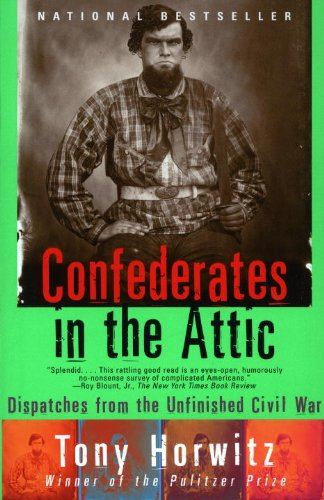
Confederates in the Attic

Confederates in the Attic

Dispatches from the Unfinished Civil War 

Tony Horwitz


Confederates in the Attic is a present day (1998) memoir of a Civil War tour. The book is appropriately titled. When you rummage around an attic, you find all kinds of junk. Junk that’s past it’s prime, odd reminders of bygone days, nostalgic twaddle, and utter fantasies. Tony Horwitz, a Pulitzer Prize-winning journalist, finds all of these and more. Unfortunately, he spends too much time in the shadowy recesses of his metaphorical attic.

The encountered characters and whimsical writing make the tour fascinating, but there’s not much substance added to lore of this bloody conflict. That’s not a criticism because the book’s intent is to investigate lingering sentiments, not to uncover facts or artifacts. The narrative actually references a lot of Civil War history and I found no errors of note. (The characters in this memoir would prefer the War Between the States, or even better, the War of Northern Aggression.)

Horwitz lives in Virginia, so he’s not exactly a Yankee peeking into odd corners to discover residue views on the war. Sometimes, however, Horwitz’s Northern education (Brown and Columbia), slants his perspective, especially when it comes to race. I found his condescending depiction of Southern racism off-putting, especially since in 1998, I lived in Boston, which was far more segregated than any Southern city. Horwitz described Atlanta as a bland and boring place unconcerned with the Civil War. My experience is that Atlanta is more representative of Southern attitudes than those portrayed by the enthusiasts for the “Lost Cause.”

Monday, November 27, 2023

Book Review: A World on Fire


A World on Fire: Britain's Crucial Role in the American Civil War

Amanda Foreman

There are plenty of history books on the Civil War, but few books that convey another country’s perspective. Amanda Foreman has done history buffs a service by providing a British perspective of our great conflict. Foreman also provides fascinating details about spy operations in Canada and some information about French, Irish, and German participation as diplomats, soldiers, and observers. Not quite a world on fire, but it’s eye opening to learn how much our civil war affected other nations.

The greatest contribution of A World on Fire is additional insight into the issue of British and French recognition of the Confederate States of America. This was the biggest political battle of the war and Abraham Lincoln beat Jefferson Davis on what many believed should have been an easy Confederate victory. If recognition had come, the South probably would have achieved independence.

A World on Fire is a dazzling research effort with most of the narrative driven from personal letters, diaries, and official documents. Unfortunately, too much of this research made it into the book. The large tome sometimes takes a deep dive into a British person’s experience for no apparent reason other than that individual kept a good diary. The perspective of a common soldier or low level officer can be valuable and interesting, but it felt out of place in a book purportedly about foreign perspectives of the war because a soldier’s experience was similar independent of their nationality. The books also jumps around in a manner that seems unnatural, with characters resurfacing after a long absence without any reminders of who they were.

In all, A World on Fire is a rare glimpse of the American Civil War from a different perspective. Considering the number of books on the subject, that is an amazing accomplishment in and of itself.


Thursday, July 21, 2022

Abraham Lincoln, by Lord Charnwood


Lord Charnwood published Abraham Lincoln in 1916. In order to get a clearer perspective of the Civil War, it helps to read books from multiple viewpoints. Lord Charnwood wrote only fifty years after the war, bringing an almost contemporaneous perspective to his depictions. His biography has the advantage of proximity but with enough time elapsed to dampen the passions of the moment. More important, as an English depiction, it is a simultaneously a distant point of view. It is a distance of more than nautical miles. Lord Charnwood also brings the bias of English nobility to his descriptions. This is exceptionally important in gaining an understanding of the diplomatic imperative for both sides. The Confederacy desperately sought European recognition of their legitimacy, while Lincoln did everything in his power to deny international recognition and suppress arms and funding from abroad. Lincoln’s success was arguably pivotal to eventually making victory possible.

 Abraham Lincoln, by Lord Charnwood can be a tough read. A simple, declarative sentence is beyond the baron. This is partly due to the style of the times and partly the way of academics who feel a need to qualify every utterance. Once the reader adjusts to the wordily writing, nuggets of rare perspective make the effort well worthwhile. For example, Thomas Jefferson is not one of my favorite Founders and Lord Charnwood seems to have shared some of my reservations. He also makes other political observations that an American might be reluctant to express.

If you have an interest in the mid-nineteenth century, Abraham Lincoln by Lord Charnwood can be an enlightening read.

Saturday, February 12, 2022

Bitterly Divided: The South's Inner Civil War


Bitterly Divided by David Williams makes sense. If the political establishment in a bunch of states decided to secede, there would obviously be inhabitants who retained a stronger loyalty to the United States of America. After all, they had been proud U.S. citizens for their entire life. I bet you saw a but coming. The but is that although Williams presents voluminous evidence of insurgence within the CSA, it is not clear that it materially hampered the Confederacy’s war efforts until the last year or so.

The catchphrase, ‘rich man’s war, poor man’s fight,’ may have been a truism, but Southern men continued to fight until victory became hopeless or they received news from home that their families were starving. Williams contends that slaveholders masterminded the war but, for the most part, non-slave holders fought it. Three-fourths of southern whites owned no slaves, so arithmetic alone proves Williams correct. 

Statistical data shows that by every economic measure, the North far outperformed the South. The only area where the South exceeded the North was in income disparity. Williams writes: “On the Civil War’s eve, nearly half the South’s personal income went to just over a thousand families.” The rich were very rich and few in number. The uneducated poor white were as omnipresent as slaves. 

At the start of the war, a recruitment broadside oddly read, “To arms! Our Southern soil must be defended. We must not stop to ask who brought about the war, who is at fault, but let us go and do battle… and then settle the question who is to blame.”

Today, that poster may not appear convincing, but decades of Democrat propaganda had bred hatred for Yankees and instilled fear of “Black Republicans.” Repeatedly, poor whites were told that freed slaves would “come into competition, associate with them and their children as equals—be allowed to testify in court against them—sit on juries with them, march to the ballot box by their sides, and participate in the choice of their rulers—claim social equality with them—and ask the hands of their children in marriage.”

When the conflict began, relentless propaganda claimed the North had invaded the South, but the Confederate Army was a reality well before Manassas. Prior to that opening battle, the North had only resisted Confederate confiscation of United States property in the seceded states. Still, men believed that they went to fight an enemy that had violated the hallowed land of the South. Why?

Jefferson Davis believed slavery gave every white person an elevated position in society independent of their lot in life. Were the poor fighting to retain this artificially elevated position? Not sure, but I’ll keep reading to find the answer.

(This is a research book for Maelstrom, a sequel to Tempest at Dawn.)

Thursday, January 13, 2022

War on the Waters, James M. McPherson


With the exception of the Monitor vs. Merrimack (CSS Virginia), naval battles get short shrift in Civil War books. McPherson certainly fills that gap with War on the Waters, The Union and Confederate Navies, 1861-1865. Land battles were certainly decisive, but the Union may have lost the war without Gideon Welles and the Navy Department. McPherson even makes a strong argument that Rear Admiral David Glasgow Farragut deserves to be ranked with generals Grant and Sherman when giving credit for the Union victory.

Inventions and innovations by both the Confederate States and the United States revolutionized naval warfare. Steam-powered ships, screw propeller driven ships, ironclads, submarines, weaponry, and naval tactics all made major advancement during those four years. By Appomattox, the United States owned the largest navy in the world, and arguably the most technologically advanced.

War on the Waters does an admirable job of describing blue water and brown water (river) battles and in explaining the significance of each clash. I found the battles that required cooperation between the Army and Navy of particular interest. As an added bonus, International law on blockades is more fully described than in other history books.

McPherson’s no nonsense writing style can sometimes verge on dull, but he always pulls the reader back to the narrative in the nick of time.

I recommend this book to all those who have an interest in the Civil War, naval battles, technology advancement, or military politics. War on the Waters is informative and a good read.

(This is a research book for Maelstrom, a sequel to Tempest at Dawn.)


Tuesday, December 21, 2021

A Short History of the Confederate States of America


After the Civil War, Jefferson Davis spent two years in prison without trial. He was released on bail and a year and a half later, the government finally dropped the treason charges against him. In 1877 he retired to Beauvoir, where he wrote, The Rise and Fall of the Confederate Government. This was a two-volume tome of over 1,500 pages. I did not read this book. I tried, but I kept following asleep. Luckily, ten years later, Davis wrote A Short History of the Confederate States of America. Roughly one-third in length, “A Short History” covers the same ground and is more readable.

Davis writing style is clear for modern readers, but I would recommend a good understanding of the war to provide context for his narrative. That said, for a thorough understanding of a major historical event, it always best to get the story from the horse’s mouth. The Davis perspective may be biased, but those perspectives did not change between the war and the writing of his memoir. That consistency makes this book valuable for understanding the motivations for war.

Davis extols victories and offers strained excuses for errors and failures. In Davis’ mind, nothing was his fault, the Confederacy was always honorable, the Union always vile. For those not imbued with The Cause mythology, this heavy-handed prejudice can be off-putting, but I found it helps understand the ethos of the period.

Most history books are written by winners. If you don’t study the losers, then you have an incomplete picture. An example would be the hallowed Federalist Papers. There is a collection of opposition opinion pieces called the Anti-Federalist Papers. I suggest reading both and I highly recommend Jefferson Davis’ A Short History of the Confederate States of America.

(This is a research book for Maelstrom, a sequel to Tempest at Dawn.)