Showing posts with label founding fathers. Show all posts
Showing posts with label founding fathers. Show all posts
Thursday, July 8, 2021

Wednesday, November 18, 2020
 |
| Michael E. Newton Hamilton Books |
The Schuyler Mansion State Historic Site in Albany, New York recently published a piece by Jesse Serfilippi titled “As Odious and Immoral A Thing: Alexander Hamilton’s Hidden History as an Enslaver.”
Was Alexander Hamilton an enslaver?
Two Hamilton historians, Philo Hamilton and Michael E. Newton, dispute the accusation.
A recent essay by Jessie Serfilippi published by the Schuyler claims to reveal, according to the work’s subtitle, “Alexander Hamilton’s Hidden History as an Enslaver.” The errors, omissions, assumptions, speculations, and misrepresentations in that essay called for a more complete and accurate evaluation of Hamilton’s history with slavery.
There is no evidence that Hamilton owned slaves or was an ‘enslaver.’ While there is evidence that he helped his in-laws with slave transactions, it appears that Hamilton in these transactions was acting merely as a banker. Regarding Hamilton himself, there are at least five pieces of evidence—two census records, a contemporary statement by Angelica Schuyler Church, a comment by John C. Hamilton in his biography of his father, and the lists of assets Hamilton drew up just prior to his death indicating that Alexander Hamilton did not own any slaves … Alexander Hamilton was on the right side of the slavery issue. In addition to not owning slaves, he actively sought to abolish the evil institution in his own state. Rather than being an “enslaver,” Hamilton opposed slavery, advocated for manumission and supported enslaved and freed blacks to the extent that his limited means allowed.
Saturday, August 31, 2019
Great Labor Day Read
 |
The real story of our nations founding
"The best novel EVER on the U.S.Constitution."--Larry Schweikart, author A Patriot's History of the United States and over a dozen other history books
"I find hope and confidence in the wonderfully written Tempest At Dawn, by James D. Best" Allen Ball, Beaufort Observer "The novel captures the real drama that ensued behind closed doors as they hammered out what is now the oldest living constitution and the foundation of the nation. Read it for its historical value. Read it for its dramatic value. But read it!"--Alan Caruba, Bookviews "Thanks to James Best's masterpiece, Tempest at Dawn, I felt like the 56th delegate at the Constitutional Convention. Using vivid narrative and expressive dialogue, Tempest at Dawn presents all the major issues the Founding Fathers struggled with."--Michael E.Newton, author of Alexander Hamilton and other history books. "This book was absolutely fabulous. When you read, it makes you feel like you are the 56th delegate. If you want a terrific historical fiction book, I recommend you start with this one." Selbrede 40Book Challenge "The book brings our founders to life with great writing, historic accuracy and amazing wit."--On Transmigration |
Tuesday, May 14, 2019
The State of History in the United States
 |
| The New York Times |
On May 11,
2019, the New York Times published Rick Atkinson's “Why We Still Care About America’s Founders.”
Atkinson is the author of the forthcoming book, The British Are Coming: The War for America, Lexington to Princeton,
1775-1777. Promotional articles are often written to
build momentum for a nonfiction book launch. Regrettably, this op-ed says more about the state
of history as a discipline than it does about Atkinson’s book.
Normally, a
book launch is a joyous occasion, especially when the tome is by a prominent
historian who has won Pulitzer Prizes in history and journalism. But these are
tough times for historians, especially historians of American history.
Progressive activists have belittled white men and toxic masculinity as the scourge
of humankind, and American history is just filled with dead, white men. Some of them slaveholders, as well. Atkinson spent years writing a history book fraught with landmines that could offend the
political correctness vigilantes. What’s a historian to do?
Grovel.
Before
getting into the meat of his article, Atkinson pays
homage to social warriors hunting for offense. Here are the first three paragraphs of his article.
There’s a lot to dislike about the founding fathers and the war they and others fought for American independence.The stirring assertion that “all men are created equal” did not, of course, apply to 500,000 black slaves — one in five of all souls occupying the 13 colonies when those words were written in 1776. Nor was it valid for Native Americans, women or indigents.Those who remained loyal to the British crown, and even fence-straddlers skeptical of armed rebellion, were often subjected to dreadful treatment, including public shaming, torture, exile and execution. In a defensive war waged for liberty and to secure basic rights, the Americans invaded Canada in an effort to win by force of arms what could not be won by negotiation and blandishment — a 14th colony.
Although
voting rights did not extend to women, slaves, or Native Americans, Atkinson
failed to mention that voting rights were broader in the United States than in
any other major power. In fact, voting rights for free males were greater in
the colonies than in Great Britain itself. (In the late 18th
Century, English voting rights were still doled out by nobility.)
The third
paragraph is just gratuitous genuflecting. Loyalists who didn’t actively work
for the British were seldom subjected to the atrocities listed, and the
Canadian invasion is likewise skewed to appear more belligerent toward
Canadians than the British. Military leaders certainly hoped to spark a
simultaneous rebellion in Canada, but if that failed, they would be content to draw
British forces to the north. American colonialists had no intention of
conquring new territory while simultaneously fighting the strongest military force
on earth.
Historians should
not skew the past to make our ancestors look better, nor should they present
the past in a way to advance the narratives of present-day social
warriors. People and events should be judged in their time, not ours.
Another
irritation with modern historians is the tendency to over-play the perspective
of ordinary people. Letters and diaries can provide contemporaneous insight,
and as a historical novelist, I greatly appreciate research into past lifestyles.
It provides me the details to bring my characters to life. But ordinary people
don’t bend history. Extraordinary people do. If we want to change our world, we
need to study how it has been done in the past.
As Theodore
White wrote, In Search of History, “Threading an idea into the slipstream of
politics, then into government, then into history…is a craft which I have since
come to consider the most important in the world.”
The Founding
of this great nation was unique. Up until 1776, with a few brief exceptions,
world history was about rulers and empires. The American experiment shook the
world. Not only did we break away from the biggest and most powerful empire in
history, we took the musings of the brightest thinkers of the Enlightenment and
implemented them. Our Founding was simultaneously an armed rebellion against
tyranny, and a revolution of ideas—ideas that changed the world.
And that is
why we still care about America’s Founders.
Monday, March 6, 2017
The Historical Novel Done Right
Go Book Yourself published a list of 9 books inspired by art. I would add a tenth: Lust for Life by Irving Stone. I am not a visual person, but my wife was an Art History major and docent, so I spend a lot of time in museums. When I look at a painting on my own, I usually stifle a yawn, but with her by my side, the art and artist become intriguing. It reminds me of NASCAR racing. If you know nothing about the sport, it's boring. Just a bunch of left turns at high speed in heavy traffic. But once you learn about the teams, drivers, cars, and rules, the sport becomes fascinating, as well as thrilling. Like my wife, Irving Stone had a knack for making something interesting that might otherwise be dull. Ever since reading Lust for Life, Vincent van Gogh has been my favorite artist.
 |
| Irving Stone |

Irving Stone is also one of my favorite authors. He popularized the biographical novel by turning the lives of great people into great stories. You can read his New York Times obituary here. The obituary quotes Stone as saying, ''My books are based 98 percent on documentary evidence. I spend several years trying to get inside the brain and heart of my subjects, listening to the interior monologues in their letters, and when I have to bridge the chasms between the factual evidence, I try to make an intuitive leap through the eyes and motivation of the person I'm writing about.''
The reason I feel an emotional connection to Irving Stone and Lust for Life is that this novel was the inspiration for Tempest at Dawn. I believed the Constitutional Convention was a spellbinding story. Dozens of history books had already been written, and I had read many of them, but there was a nail-biting story filled with enigmatic characters that somehow eluded these academic examinations. Like Stone, I felt the novel form would bring the story and people to life. I may not have reached the literary heights of Stone, but I enjoyed the writing immensely and most readers have been highly positive in their reviews and ratings. (565 Goodreads ratings for 3.9 stars and 208 Amazon reviews for 4.4 stars..)
Try either book. If you enjoy history, you may find the novel a great form for gaining additional insight.

Try either book. If you enjoy history, you may find the novel a great form for gaining additional insight.
Friday, July 1, 2016
Alexander Hamilton Fixed a Broken Nation

Due to the groundbreaking play, Alexander Hamilton has
vaulted skyward to become an icon of popular cultural. It couldn’t happen to a better man. Hamilton
was my favorite character when writing Tempest at Dawn. At the time of the
Constitutional Convention he was only thirty years of age, yet he had already proved
his physical courage and mental agility.
When writing my novel, I used the following excerpt to illustrate the
economic conditions faced by the infant nation. Most of the states had not paid
off the war bonds that financed the Revolution, foreclosures were rampant,
inflation raged, there was no common money, and production, especially for
ships and foodstuffs, had declined to the point of alarm. These were the dire circumstances
inherited by Alexander Hamilton when he became our first Secretary of the
Treasury. In a tour de force, he righted the country’s finances and economy by
the end of Washington’s first term.
When Baldwin emerged from behind the building, he failed to notice his friends on the other side of the road, so he walked into the tavern. He spent only a few minutes inside and emerged with a wooden bowl and an oversized spoon. Looking around, he finally spotted Sherman and Hamilton on the log across the way.
As he took a seat next to Sherman, Baldwin asked, “What’s this?”
Hamilton leaned forward to look around Sherman. “Squirrel, I think.”
“God, I hate traveling.”
“Throw it away, and I’ll give you a pear.”
Baldwin dipped his spoon deep into the concoction and let the goo plop back into the bowl. “This looks like pig swill.” He ceremoniously turned the bowl over, and they all watched the pottage spill onto the ground in bumpy chunks.
“My money says that blob will still be there on my return trip,” Hamilton said.
Baldwin turned the pear a couple times and then took a huge bite. After a noisy chomp, he spoke with a mouth half full. “I’ll not take that bet; forest animals have more dignity.”
Friday, March 28, 2014
John Adams, Philosopher Rebel
John Adams was the leading expert on
government in the colonies … at least until James Madison stepped to the
forefront. Harvard educated, Adams was a champion of the Founding Principles, a
firm proponent of Enlightenment teachings, and a constitutional scholar.
Granted, he could be argumentative and self-righteous, but he was also a pious
man of honor and character.

Wednesday, March 26, 2014
The Founders—A Mixed Lot
People
frequently refer to the Founders as if they were a homogenous group. They did
share a belief in key principles, but they were very different in other
respects. For example, George Washington was a wealthy plantation owner, but
his top officers in the Revolution included Major General Nathanael Greene, who
entered the war as a militia private and was the son of a small farmer; Major
General Henry Knox, a Boston bookstore owner who later became President
Washington’s Secretary of War; and Lieutenant Colonel Alexander Hamilton, born
illegitimate in the West Indies to a struggling mother who died when Hamilton
was thirteen. Hamilton went on to become the first Secretary of the Treasury.

Monday, March 24, 2014
Thomas Jefferson, Rebel with a Cause
Thomas
Jefferson was a planter, architect, revolutionary, author, agricultural
scientist, inventor, and politician. He did other things in his spare
time. His tombstone is inscribed, “Here was buried Thomas Jefferson, author of
the Declaration of American Independence, of the Statute of Virginia for
Religious Freedom, and father of the University of Virginia.” The inscription says nothing about a
presidency where he reduced spending, cut taxes, kept us out of war, and
doubled the land mass of the country. He wrote the epitaph himself and included
the accomplishments that he took the most pride in.
 Jefferson was in France during the Constitutional Convention, but the Declaration of
Independence is possibly the most hopeful and eloquent statement of the Founding
Principles. On June 11,
1776, the second Continental Congress appointed a committee to write a
declaration of independence. Besides Jefferson, John Adams, Benjamin Franklin,
Robert R. Livingston, and Roger Sherman were selected. One of these five was a
renowned author. Benjamin Franklin’s Poor Richard’s Almanac and his newspaper
articles in the Pennsylvania Gazette had made him the best-known writer in
North America. But Franklin declined to draft the declaration, supposedly due
to poor health, so the committee asked the thirty-three-year-old Thomas
Jefferson to draft the document.
Jefferson was in France during the Constitutional Convention, but the Declaration of
Independence is possibly the most hopeful and eloquent statement of the Founding
Principles. On June 11,
1776, the second Continental Congress appointed a committee to write a
declaration of independence. Besides Jefferson, John Adams, Benjamin Franklin,
Robert R. Livingston, and Roger Sherman were selected. One of these five was a
renowned author. Benjamin Franklin’s Poor Richard’s Almanac and his newspaper
articles in the Pennsylvania Gazette had made him the best-known writer in
North America. But Franklin declined to draft the declaration, supposedly due
to poor health, so the committee asked the thirty-three-year-old Thomas
Jefferson to draft the document.
Sunday, March 16, 2014
Happy Birthday, Mr. Madison
March 16, 2014 marks the 263rd birthday of James Madison.
In his later years, James Madison protested being referred to as the Father of the Constitution. He said the document was not “the off-spring of a single brain.” Our Constitution was actually the off-spring of fifty-five brains, although none were as potent as Madison’s. James Madison was arguably the most important Framer—before, during, and after the Constitutional Convention of 1787.
 |
| James Madison |
In 1786, the country was at peace, but struggling. Congress called for a convention at Annapolis to offer amendments to the Articles of Confederation, but the meeting never convened due to the lack of a quorum. James Madison and Alexander Hamilton made a pact to promote another convention for the following year in Philadelphia.
Friday, March 14, 2014
The Happiness or Misery of Millions Yet Unborn

(Excerpt from Principled Action)
The truly exceptional work in the founding began after the war for independence was won. During the Constitutional Convention , George Mason wrote, “The revolt from Great Britain and the formations of our new governments at that time, were nothing compared to the great business now before us; there was then a certain degree of enthusiasm, which inspired and supported the mind; but to view, through the calm, sedate medium of reason the influence which the establishment now proposed may have upon the happiness or misery of millions yet unborn, is the object of such magnitude, as absorbs, and in a manner suspends the operation of the human understanding.”
The writing and ratification of the Constitution made the United States of America unique. The origins of our republic were not by the sword, but through the calm, sedate medium of reason. There was a long and bloody revolution, but four years of peace had calmed the infant nation before the Founders collectively sat down to debate the design of a republic for millions yet unborn.
Monday, February 10, 2014
Why did the colonists revolt?
In the five centuries following the Magna Carta (1215),
Englishmen had gradually gained individual rights, so that by the late
eighteenth century, the English were beginning to exercise a degree of
self-government. The King and nobility still wielded substantial power, but
Parliament had gained increasing authority, especially the elected House of
Commons.
Toward the end of this period, the opinions of those outside the aristocracy were increasingly influenced by the Enlightenment, an intellectual movement of the seventeen and eighteenth centuries. Enlightenment thinkers began to challenge existing religious, government, and social norms, and pushed for additional individual liberty and the free exercise of natural rights. They argued that mankind not only had a capacity for self-government, but that it was a natural right. Through an evolutionary process, Englishmen grew to enjoy an ever-increasing say over who made the laws that governed their lives. That is, those Englishmen who lived in England. If an Englishman happened to live in one of the British colonies, he was still a mere subject of the crown with no representation in Parliament.
Toward the end of this period, the opinions of those outside the aristocracy were increasingly influenced by the Enlightenment, an intellectual movement of the seventeen and eighteenth centuries. Enlightenment thinkers began to challenge existing religious, government, and social norms, and pushed for additional individual liberty and the free exercise of natural rights. They argued that mankind not only had a capacity for self-government, but that it was a natural right. Through an evolutionary process, Englishmen grew to enjoy an ever-increasing say over who made the laws that governed their lives. That is, those Englishmen who lived in England. If an Englishman happened to live in one of the British colonies, he was still a mere subject of the crown with no representation in Parliament.
 |
| Benjamin Franklin before Lords in Council in Whitehall Chapel |
Tuesday, February 4, 2014
A Time of Civil Debate
A rowdy debate consumed nearly everyone in the United States
between the Constitutional Convention and ratification. The population of the
country was about four million and possibly a quarter of that
number were activists during the Revolution and founding. What did people think
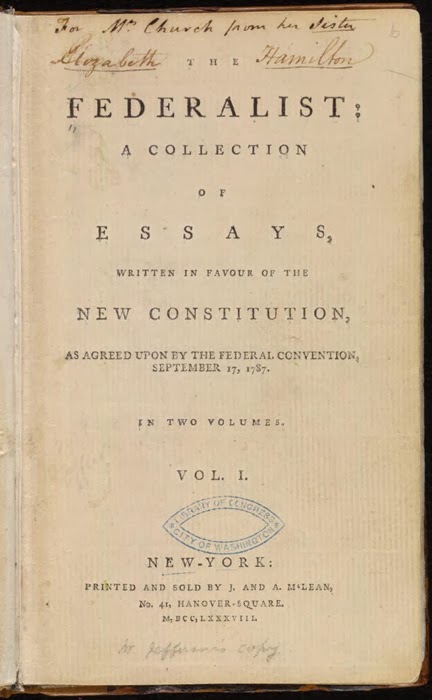
about a constitution written in secret? We don’t have to guess. A prodigious number of
articles and pamphlets were published by proponents and opponents.

Sunday, February 2, 2014
Can Tempest at Dawn be taken seriously?
Tempest at Dawn is
a novelization of the Constitutional Convention. As a novel, it is not bound by
the rigorous constraints of a nonfiction history book, but it does not deviate
from the historical record except for modernizating language, re-sequencing of debates for logical presentation, and attributing a few speeches to a different delegate
because that person was already established as a character. It’s confusing to
tell a story with more than sixty characters, so I had to choose a
representative sample and occasionally attribute to them the words or actions
of others.
.jpg "Tempest at Dawn by James D. Best") |
| The real story of our nation's founding. |
James Madison’s
comprehensive convention notes provided a solid framework for what happened inside
the locked doors of the Pennsylvania State House. The events outside the State
House occurred, but literary license was used because there were very few recorded
details about them. For example, Franklin’s dinner, the John
Fitch Steam Boat demonstration, horse races, and George Washington having a carriage built were all outside activities during the convention. The Fourth of July celebration happened pretty
much as portrayed, and delegates did witness a two story house being moved down
the street.
Other than speeches, conversations were speculative, but based to
a large degree on what must have been discussed in private meetings to shift
the votes and opinions expressed in the proceedings.
Tuesday, January 28, 2014
How to study the Constitution
The study of the
Constitution can seem daunting to those who want to gain a greater
understanding of this unique document. To begin with, there are eight historic periods
that shaped our Constitution.
- Constitutional Convention
- Public debate on Constitution as reflected in the Federalist and Antifederalist Papers
- State Ratification Conventions
- First Congress and Bill of Rights
- George Washington precedents
- Supreme Court Rulings
- Amendments beyond the Bill of Rights
- Executive encroachment with emphasis on Jefferson, Lincoln, Wilson, FDR, and Obama
As a constitutional conservative, I recommend starting with
the convention and the Framers. Besides, it’s always a good idea to start at
the beginning.

There are countless history books on the Constitutional
convention. In these books, the convention is usually presented in one of two
ways: chronologically or by subject.
Sunday, January 19, 2014
Time Magazine: “Does It Still Matter?”
“Let us not make it a blank paper by
construction. ... If it is, then we have no Constitution.” Thomas Jefferson
“Can it be of less consequence that the meaning
of a Constitution should be fixed and known, than a meaning of a law should be
so?” James Madison

The cover of the 10th Annual Time Magazine History Issue
from a couple years ago shows the Constitution being shredded under the title,
“Does it still matter?”
Richard Stengel, Time’s managing Editor, opens his essay
with these words, “Here are a few things the framers did not know about. World
War II. DNA. Sexting. Airplanes. The atom. Television. Medicare. Collateralized
debt obligations. The germ theory of disease. Miniskirts. The internal
combustion engine. Computers. Antibiotics. Lady Gaga."
Monday, January 13, 2014
Commentary: Is the Constitution’s purpose to advance life, liberty, and the pursuit of happiness?
Conor Friedersdorf published an article that reflects the thinking that has gotten
us so far away from constitutional government.
The
title of the article is illustrative: “Preserving Liberty Is More Important
Than Making a Fetish of the Constitution: Though important,
the document isn't an end in itself—advancing life, liberty, and the pursuit of
happiness is the end.” The title could have as easily read, “The Constitution
should never stand in the way of lofty goals.”
 |
| James Madison |
 |
| Conor Friedersdorf |
(I trust my liberty to the guy on the right.)
As
a writer, I’m familiar with the effect of selecting emotion-laden words. For
example, the article would have been different if titled, “Preserving Liberty
Is More Important than Adhering to the Constitution.” The change from fetish to adhere makes the argument clear and allows the opposing side a
measure of respect. Now, readers would dig into the article to find out whether
adherence to the Constitution is dangerous to liberty.
(By
the way, at the risk of being accused of “making a fetish of the Constitution,”
it annoys me when someone uses a quote from the Declaration of Independence to
make an argument about the Constitution.)
Thursday, January 9, 2014
The Heritage Guide to the Constitution
A
reference Book for Every American Home

As you would expect from the Heritage Foundation, this is an Originalist reference book, and the editors have done an excellent job of explaining the Constitution as envisioned by the Framers. But it also explains the Constitution as applied in contemporary law, which means the book describes how courts have interpreted the Constitution.
Wednesday, December 11, 2013
The Founders on Excessive Government Power
The Founders distrusted overly strong governments. That’s why they engineered a limited
republic. Today, Americans seem to turn to their government to validate and
protect real and presumed rights, and increasingly rely on government to
guarantee the substance of life. Many
modern Americans embrace national authority and fight to enlarge governmental
powers. The Founders would be appalled.
What would the Founders think about growing government
power? Here is what they said in their own words.

In our governments the real power lies in the majority of the community, and the invasion of private rights is chiefly to be apprehended, not from acts of government contrary to the sense of its constituents, but from acts in which the government is the mere instrument of the major number of the constituents. Wherever there is an interest and power to do wrong, wrong will generally be done. – James Madison
Sunday, December 8, 2013
What happened in those secret meeting in 1787?
“Can it be of less consequence that the meaning of a Constitution should be fixed and known, than a meaning of a law should be so?”—James Madison
Fifty-five men came to Philadelphia in May of 1787 to
secretly plot the overthrow of the United States government. At first, a coup was not subscribed to by all the participants, but most of them soon acquiesced to framing
an entirely new form of government. At the time, this conclave was called the Federal
Convention; today we refer to it as the Constitutional Convention.
 |
| James Madison, circa convention |
One of the first acts of the convention was to
declare the proceedings secret. There was a general fear that newspapers would
excite Congress and the populace against abandoning the Articles of
Confederation. The windows were nailed shut and guards posted at the doors. Delegates
were lectured by George Washington never to whisper a word to anyone about what
was happening inside the chamber. The official minutes are scanty, recording
little beyond an official tally of the votes. A few delegates made private notes,
but of those, only one attended every day and wrote everything down. James
Madison purposely sat in front so he could take extensive notes of all the
deliberations. He recorded the proceedings in his own shorthand, and then
transcribed his daily notes into longhand. When finally published in 1840, Madison’s
notes exceeded 230,000 words—all written with a quill pen.
Subscribe to:
Posts (Atom)